
Executive Summary
In this article, we explore how the ML6 Talent & Culture team built an AI-native employee feedback system in less than one day.
We explain:
• why traditional employee engagement surveys often fail
• how pulse surveys and Net Promoter Score (NPS) help measure real-time sentiment
• how AI-native tools like Lovable enable HR teams to build internal applications without engineering support
• what results we observed after launching our internal “vibe check”
This case illustrates a broader shift: moving from tool users to tool builders, using AI to automate processes, gain faster insights, and improve employee engagement.
From Traditional Surveys to an AI-Native Approach
Most employee engagement surveys still end up in spreadsheets.
HR teams spend weeks collecting responses, exporting data, and building dashboards that are often outdated the moment they are finished.
At ML6, we asked ourselves a different question: what would an AI-native employee feedback system look like?
We built our internal pulse survey platform — including automated dashboards — in a single day.
At ML6, we attach great importance to employee satisfaction and encourage an open feedback culture. We divide this satisfaction into several dimensions: satisfaction within our company, within the job, and within active projects. This is particularly important because many of our people work on projects for clients.
In this blog post, we share how our Talent & Culture team started exploring an AI-native approach to employee engagement surveys, and what we learned along the way.
Why Traditional Employee Engagement Surveys Break
Many organizations still run engagement surveys in a way that hasn’t changed in a decade:
- Surveys are run once or twice a year
- Data lives in spreadsheets
- Analysis takes a lot of time
- Insights arrive too late to act on
By the time results are discussed, the situation on the ground may already have changed.
In project-based organizations like ML6 — where employees continuously rotate across client engagements — static surveys simply don’t capture reality fast enough.
That’s why we started with continuous pulse surveys.
Setting up our Pulse Survey
We deliberately measure the satisfaction of our people within the job and project on a monthly basis, so that we can initiate conversations about this at regular intervals. This is a kind of ‘Pulse Survey’ in which we measure the NPS (Net Promoter Score). The main question asked in this survey is: ‘how likely are you to recommend your current job to peers?’ and ‘how likely are you to recommend your current project to peers?’. Initially, we built and analyzed this survey ourselves using forms and Excel sheets. It works, but let's be honest, it's not very appealing nor efficient.
Net Promoter Score (NPS) is a widely used metric to measure satisfaction and loyalty. Participants rate how likely they are to recommend something on a scale from 0 to 10.
Scores are then grouped into:
- Promoters (9–10)
- Passives (7–8)
- Detractors (0–6)
AI Native Way of Working
At ML6, we attach great importance to ‘drinking our own champagne’, or ‘practicing what you preach’. As an AI-native company, we believe it is only natural that we also review our internal processes to see where AI can make our work easier and more efficient.
When we started exploring ways to improve our employee surveys, we quickly realized that there is now a wide range of tools available. The real question becomes: what exactly do you want to measure, what do you want to analyze, and what matters most to you? (UX/UI, privacy, pricing, adoption, etc.).
This naturally leads to another important question: is it better to buy an existing tool, or build something yourself?
Build vs Buy: A Common AI Decision
When exploring AI tools internally, teams often face the same dilemma:
Should we buy software or build something ourselves?
Buying tools can provide structure, support, and faster onboarding.
However, modern AI-native development tools have dramatically lowered the barrier to building custom internal applications.
For our use case — a relatively lightweight internal feedback system — building turned out to be faster and more flexible.
Tools like Lovable allow teams to prototype working applications simply by describing what they want to build. In many cases, this enables operational teams to create solutions themselves, without needing extensive engineering support.
Within ML6, we have a dedicated AI native way of working team that facilitates AI adoption in all department’s processes and toolings. Lovable is one of those tools we are heavily exploring within ML6. This triggered our Talent & Culture team as well. What could/should we build ourselves that makes real business impact and relieves an operational workload of our team?
Introduction to Lovable
Lovable is a “chat-to-build” platform that allows you to build beautiful software applications. Basically, you tell a chatbot what you want to build, what features and extensions you want in your application, and Lovable builds it for you. (For a deeper dive into how these tools work, see our earlier blog on The Anatomy of a Lovable App.) Since we had already collected a lot of data from our past surveys, we were able to easily inject our way of working and Excel sheets into Lovable, allowing it to easily take over the structure of the surveys.
What makes Lovable very user-friendly, in my opinion, is the tool's understanding. Even if your explanation is very vague, the tool turns it into something concrete and tries to translate what you mean. It also shows you what it thinks and how it came to a conclusion, which helps in understanding each other better. It also makes suggestions to make things more user-friendly and has an eye for UX/UI.
How the System Works
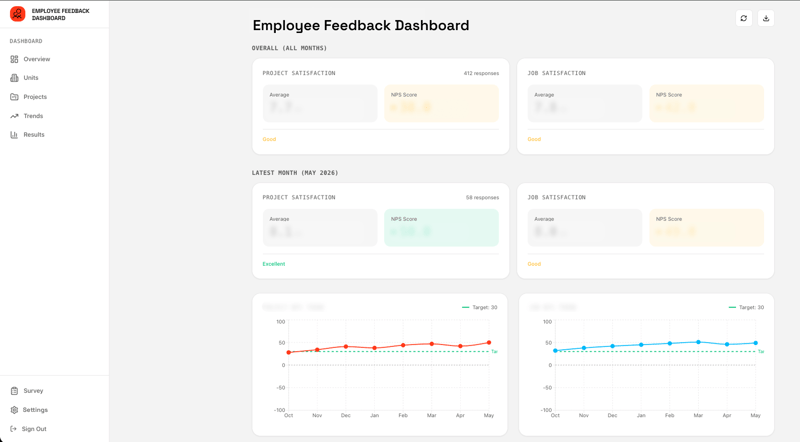
We used Lovable to build our internal pulse survey (“vibe check”), combining both the survey flow and a real-time analytics layer.
The application includes:
- A dynamic Survey interface tailored to business units
- Project-level feedback selection
- Automated email invitations and reminders
- Anonymous data collection
On top of that, we built a live dashboard for department coaches, allowing them to monitor team sentiment in real time.
The dashboard aggregates responses and highlights trends across:
- Job satisfaction
- Project satisfaction
- Recommendation likelihood
This enables leaders to quickly identify potential issues and start relevant conversations early, rather than reacting weeks later.
Outcomes
Example: Early Results
Although the system is still new, the impact was visible immediately:
- The platform was built in less than one day
- Survey participation increased compared to previous cycles
- Data analysis time dropped from hours to seconds
- Coaches now have live visibility into team sentiment
Instead of reviewing feedback weeks later, teams can now react almost in real time.
These early results highlight a fundamental shift in how employee feedback can be managed. What was previously a slow, manual process has become a continuous, real-time feedback loop.
Rather than collecting data and analyzing it retrospectively, teams can now observe sentiment as it evolves, enabling faster conversations, earlier interventions, and more proactive support.
For us, our vibe check is not a control tool or a means of evaluating performance. Rather, it is a light check-in designed to start relevant conversations within teams and help each other where needed. We see it as a reinforcement of our learning and feedback culture.
The most surprising part of this was how quickly the system came to life. Setting up the survey and dashboard in Lovable took roughly a day, and we did it entirely ourselves with the support of our internal AI Native way of working team on the security and quality checks.
On a personal note, I was genuinely impressed by the outcome. After only about an hour of chatting with Lovable (which honestly felt like chatting with a friend who keeps pushing your thinking), it already generated a very elaborate and polished dashboard, something that would normally have taken me weeks to build manually.
Advice for HR Teams Exploring AI
For HR teams considering their own AI-native initiatives, our advice is simple: start with the problem, not the technology.
Ask yourself:
- What process currently consumes a lot of operational time?
- Where are inefficiencies slowing your team down?
- What do you actually want to measure or improve?
- Where could AI help and where should it deliberately not be used?
Then explore what already exists on the market and consider whether buying or building is the best option.
And most importantly: don’t be afraid to experiment.
Today, building internal tools no longer requires deep technical expertise, but still benefits from the right guidance and validation to ensure quality and scalability.
Conclusion
The biggest takeaway from this experiment wasn’t just the tool we built.
It was how quickly ideas can turn into working systems today.
In less than one day, our Talent & Culture team built an internal pulse survey platform that:
- collects employee feedback
- generates live dashboards
- enables real-time conversations between teams and coaches
With AI-native development tools, building internal software is no longer limited to developers.
For HR teams, this opens a completely new way of working: instead of waiting months for a tool — you can prototype one in a day.