
Executive Summary
In liberalized power markets, real-time instability is no longer just an engineering problem - it is a significant financial risk. As the energy transition accelerates, the ability to anticipate system imbalance has become the key to avoiding penalties and capturing value. Belgium serves as a sharp test case for this universal challenge: with an average of €188M in yearly imbalance costs locally, the value of precise, real-time signals is undeniable.
This post kicks off a two-part series on how we solved this challenge. We built a production-grade AI system that doesn't just work in theory - it outperforms the Belgian TSO’s own reference forecast by 16% under live, operational constraints. While Part 1 focuses on the intelligence and results behind this edge, Part 2 will reveal the MLOps machinery that keeps it running 24/7.
The context: A grid under pressure
As the energy transition accelerates, power systems are becoming harder to steer in real time: intermittent renewables, new consumption patterns, and tighter operational margins make short-term uncertainty an everyday reality.
In Belgium alone, the average yearly imbalance cost over the last 5 years - paid by market participants - reached 188M euros1. In that context, one signal has become increasingly valuable to both grid operators and market participants: System Imbalance (SI).
In this two-part series, we share how we built a production-grade AI system that forecasts system imbalance under real-time constraints - and why this matters for grid stability and market participants alike.
- Part 1 (this post) focuses on the why and the intelligence: the domain problem, the value of forecasting, and the live results.
- Part 2 will lift the hood on the MLOps machinery that keeps this model running reliably 24/7, covering data ingestion & warehousing, automated training and live inference & monitoring.
The headline result: our live forecast of the current quarter-hour system imbalance in Belgium using only publicly available data achieves a 16% lower Root Mean Square Error (RMSE) than the TSO’s reference forecast over the last weeks, under real operational conditions.
This improvement translates directly to operational value: for grid operators, it means smoother balancing; for market participants, it enables more precise asset steering to mitigate risk and capture value in a volatile market.
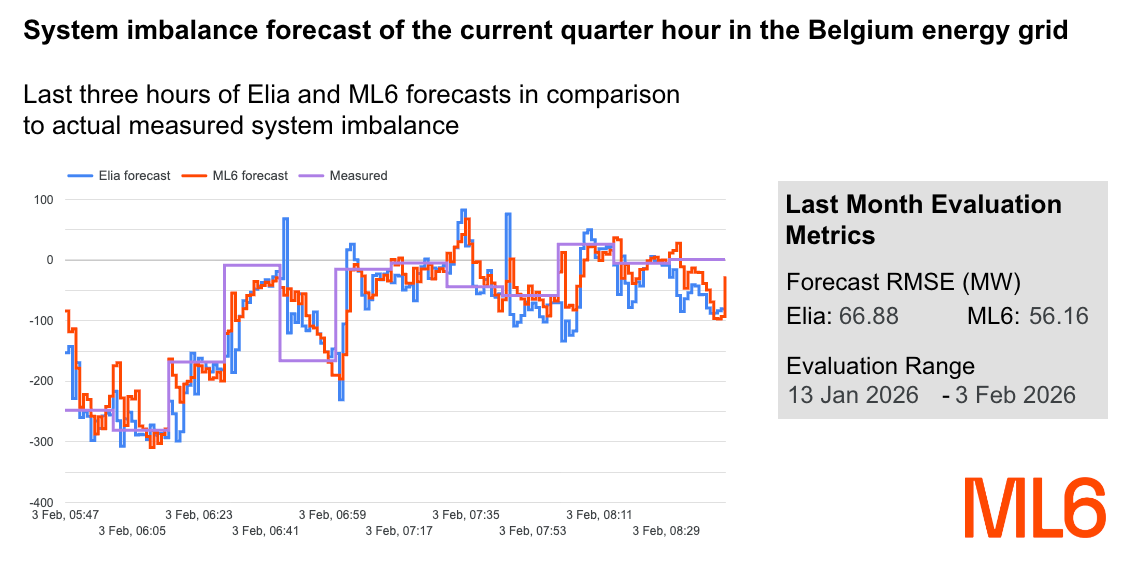
🔴 LIVE DATA
View the real-time forecasting dashboard →
The grid’s heartbeat: why 50 Hz is non-negotiable
Europe’s power grid operates as a single synchronized machine. Its health is expressed through one number: 50 Hz.
That frequency reflects the real-time balance between electricity generation and consumption. When supply exceeds demand, frequency rises. When demand exceeds supply, frequency falls. Even small deviations matter: industrial equipment, protection systems, and interconnectors are designed to operate within tight frequency tolerances.
The physical mismatch behind these deviations is known as System Imbalance (SI). It is measured in megawatts and continuously fluctuates as millions of decisions, forecasts, and assets interact across the grid.
A useful way to think about system imbalance is this:
System imbalance is the sum of everyone’s forecasting errors.
If every market participant could perfectly predict consumption, renewable output, and asset availability, system imbalance would be zero. In reality, that is no longer achievable at scale.
The energy transition amplifies this problem. Variable renewable generation introduces fast ramps and weather-driven volatility, while inverter-based assets reduce the grid’s natural inertia. Electrification adds new consumption patterns that are harder to anticipate at fine temporal resolution.
The financial data reflects this shift: the average yearly imbalance cost of 188M euros over the last 5 years is a staggering 4.3x higher than the 5 years preceding it. The result is a grid where imbalance swings are larger, faster, and more frequent - making the ability to anticipate short-term dynamics increasingly valuable.
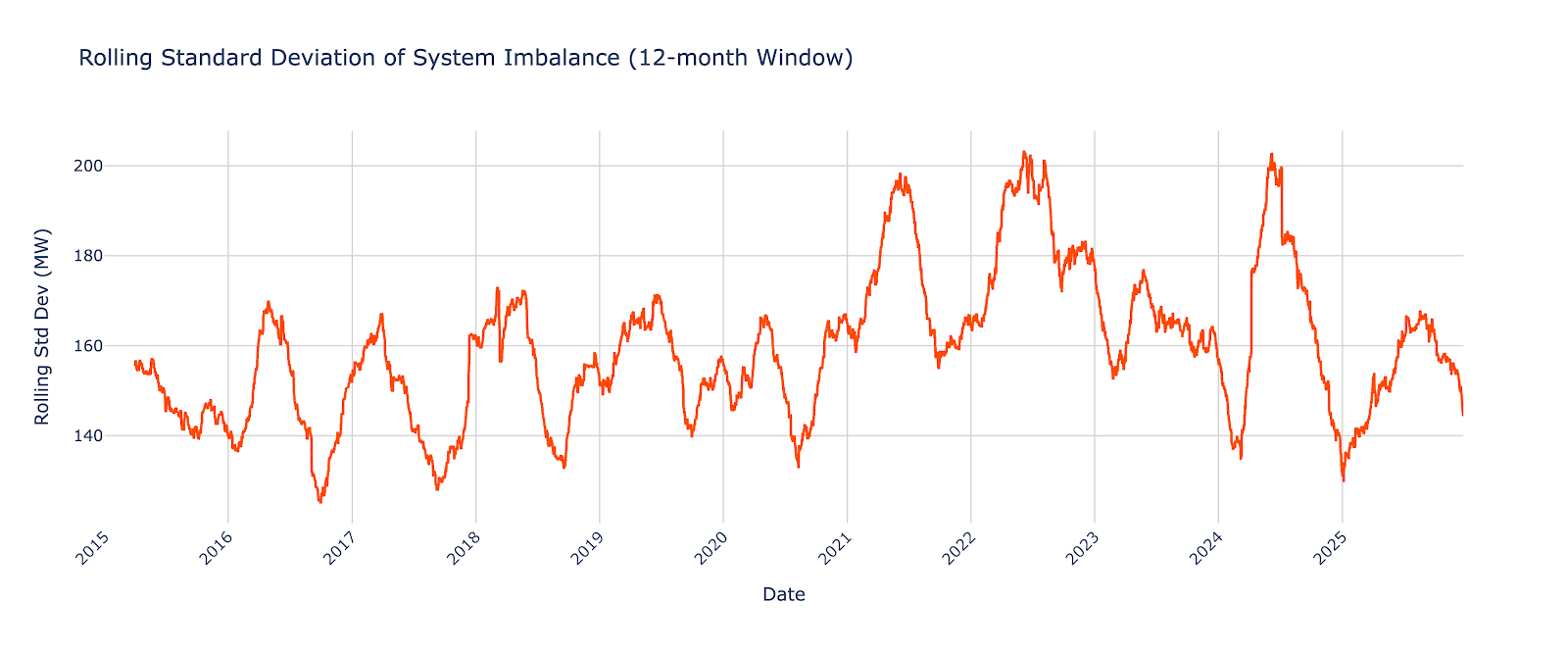
Fig: Increasing volatility of system imbalance over time - a structural increase in volatility since 2021. Source: Elia Open Data platform.
🔎 For readers interested in the technical formulation, see the optional deep dive below.
For the curious: what SI represents in practice
Elia (Belgium’s TSO) defines the instantaneous system imbalance at any time t as a reconstruction of the gross imbalance that would exist without corrective balancing activations. Formally (see Elia’s T&C for BRPs ):
SIₜ = ΔPₜ + kΔfₜ − (aFRRₜ + mFRRₜ)
Where:
- ΔPₜ captures the deviation between scheduled cross-border exchanges and actual physical flows.
- kΔfₜ represents the frequency control error (in MW).
- aFRRₜ and mFRRₜ are activated balancing reserves subtracted to reconstruct the gross imbalance.
From physics to euros: how imbalance becomes financial exposure
System imbalance is a physical quantity, but it is managed through market mechanisms.
In liberalized electricity markets, the Transmission System Operator (TSO) is responsible for real-time stability. When the system drifts out of balance, the TSO activates balancing reserves to restore frequency. Those actions are essential - and costly. Rather than socializing those costs blindly, the market assigns responsibility through the imbalance settlement mechanism.
Every Balancing Responsible Party (BRP) commits to a schedule: how much energy it will inject or consume. Reality inevitably deviates from that plan. The difference between nominated and metered energy is settled financially at the imbalance price, reflecting the marginal cost of balancing actions. This settlement happens per Imbalance Settlement Period (ISP), which is every quarter hour in Belgium.
This market design creates a crucial alignment between physics and finance. BRPs are penalized when their deviation aggravates the system imbalance - and exposed less, or even rewarded in Belgium, when their deviation counteracts it.2
This dynamic naturally leads every market participant to ask two questions:
- "Could I have avoided this penalty?" (Risk reduction)
- (In Belgium) "Could I have made even more money?" (Revenue optimization)
This is what turns system imbalance from a metric into a signal. Knowing whether the system is trending long or short, and how significantly it will deviate before the quarter hour closes, is the key to answering those questions.
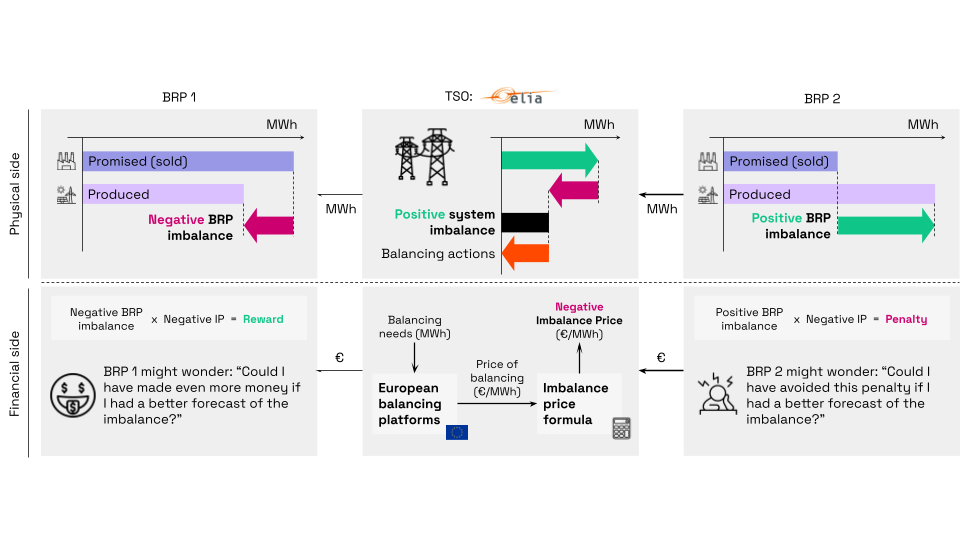
Fig: The physical and financial sides of imbalance, illustrating the implicit balancing mechanism in Belgium.
Why the real-time horizon matters when forecasting imbalance
Imbalance forecasting is not one problem - it’s a family of problems, depending on the “window of opportunity” you operate in:
- Day-ahead horizon: structural planning (unit commitment, hedging, scheduling)
- Intraday horizon: trading and position management up to gate closure
- Real-time horizon: minute-to-minute steering in and around the current quarter-hour
In this first release of our imbalance forecasting project, we focus on the real-time horizon, more specifically intra-quarter-hour system imbalance forecasts, where immediate value is unlocked for TSOs and BRPs.
For TSOs, better short-term visibility supports smoother and more anticipative balancing actions. For BRPs, it enables intra-quarter-hour imbalance steering with flexible assets, like (dis)charging Battery Energy Storage Systems (BESS), ramping up or down generation or triggering curtailment to align with the system's needs - and the market's incentives - before the settlement period closes.
What intra-quarter-hour system imbalance forecasting means
System imbalance is continuous, but it is not observed or settled continuously.
In Belgium, the TSO publishes imbalance data at multiple resolutions: minute-level values, cumulative values within the quarter hour, and a final quarter-hour average used for settlement. As a quarter hour progresses, the cumulative signal gradually converges toward that final value.
Our forecast targets that final quarter-hour outcome, even while the quarter hour is still ongoing. Concretely, we produce a minute-by-minute forecast of the imbalance outcome for the quarter hour currently in progress.
Early in the quarter hour, uncertainty is high: only a small fraction of the interval has been observed. As time advances and more data becomes available, uncertainty collapses and the forecast converges.
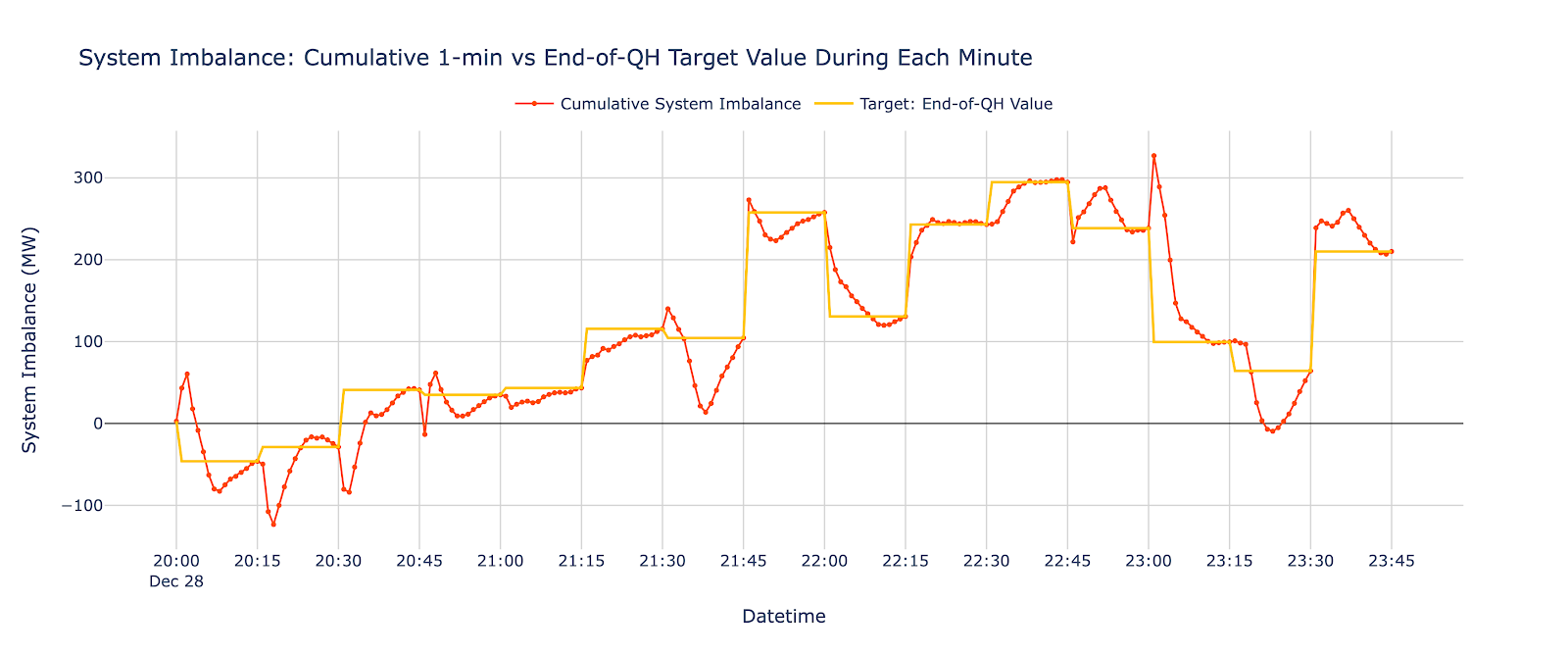
Fig: The target remains constant within the quarter hour & the cumulative system imbalance converges towards the final quarter hour value.3
The hard part: Forecasting under real-time operational constraints
A real-time forecast is not simply a modeling exercise; it is an engineering challenge defined by operational constraints. In a live environment, minute-level signals face non-zero publication delays and frequent revisions (e.g., wind/solar forecasts updating as the forecast horizon shortens and accuracy improves). A system trained & tested on perfect historical data - without accounting for these lags and updates - will silently fail when faced with production reality.
We treat data availability as a first-class feature:
- During backtesting: We design our evaluation like a "time machine." We freeze the data exactly as it existed at the historical moment of prediction. We do not use the "final, corrected" values that are published days later; we use the delayed, sometimes noisy values that were actually live.
- During live inference: Our model is architected to handle missing data streams gracefully. If a specific signal is delayed beyond its usual latency, the model doesn't crash - it infers based on the remaining available state and the last known valid points.
This ensures our reported improvements reflect live conditions, not a theoretical "best case" lab setup.
A high-level view of our approach
Our forecasting system is built entirely on publicly available data from Elia’s Open Data platform, proving that performance comes from engineering and modeling choices - not exclusive access.
At a high level, the system combines:
- near-real-time operational signals (ingested as they arrive, handling real-world latency),
- forward-looking system drivers available at quarter-hour resolution,
- non-linear machine learning models capable of capturing intra-quarter-hour dynamics,
- and a production-first design that treats latency, missingness, and monitoring as core requirements.
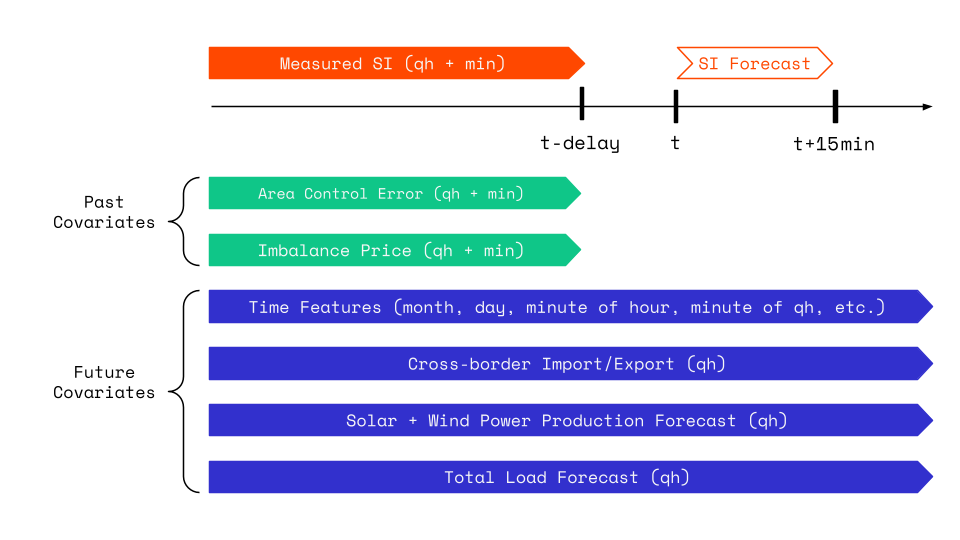
Fig: Our model fuses delayed operational signals (past covariates) with forward-looking drivers (future covariates), respecting the strict delay of live data streams.
Results: beating the benchmark
The ultimate test of a forecast is how it performs live.
Over the last several weeks, our current quarter-hour forecasts achieved a 16% lower RMSE than the public reference forecast published by the Belgian TSO.
But the average doesn't tell the whole story. When we evaluate errors minute by minute, the performance gap is greatest early in the quarter hour - precisely when uncertainty is highest.
- For TSOs: This means earlier situational awareness, allowing for more anticipative balancing decisions rather than reactive corrections.
- For BRPs: This means gaining high-confidence directional insights minutes ahead of the market, allowing for optimized asset steering that avoids penalties.
Closing
The energy transition is making the grid harder to predict, but AI, when engineered correctly, makes it easier to steer. While the Belgian market provided a sharp test case, the underlying challenge of volatility is universal. The architecture and methodology we developed are portable, making short-term operational forecasting a core capability for any liberalized electricity market.
But predicting volume is just the first half of the equation. To close the loop between grid stability and market strategy, we are actively working on an Imbalance Price forecast that builds directly on these signals to predict financial exposure in real time.
Inspired? Let’s connect and make it happen. Reach out to discuss how we can help you unlock value from your energy data.
Stay tuned for Part 2, where we’ll dive into the MLOps machinery that keeps this system running 24/7, unpacking our architecture for streaming data ingestion, continuous model retraining, and resilient real-time serving.
1 Computed based on the imbalance price and system imbalance published by Elia on their Open Data platform.
2 This statement is true when considering the broader European grid. Since the introduction of the European balancing platforms MARI and PICASSO, BRPs are incentivized to solve the broader imbalance in Europe. Therefore, local BRPs might be incentivized to aggravate the local system imbalance when the broader European imbalance points in the opposite direction.
3 To make this graph conceptually more clear, we have shifted this graph by one minute and we compare against the final cumulative minute-level value of the system imbalance instead of the true finalized quarter hour value.

tomorrow’s
volatility
with AI.