

Executive Summary
Managed Agent Solutions (MAS) are cloud-managed platforms for building, deploying, and operating AI agents. They remove the need to manually set up infrastructure for orchestration, memory, tooling, tracing, guardrails, and evaluation, allowing teams to reach production faster.
MAS have matured from early, UI-focused experiments into platforms that support production workloads across many GenAI use cases. They are not a universal solution. Custom agent solutions are still required when teams need advanced observability, custom evaluation, strict cost control, portability, or complex orchestration.
The Choice Every Agent Builder Faces in 2026
If you’re building agents today, you will face the decision: do you rely on a managed agent solution provided by your cloud vendor and/or model provider, or do you leverage an agent framework but deploy it yourself?
Until recently, the answer was often obvious. Managed solutions lagged behind in production needs, while custom solutions offered the flexibility required for production. That balance has shifted. Managed agent solutions have matured quickly, and many of the problems teams used to solve manually are now handled out of the box. The question is no longer whether MAS are production-ready, but whether they fit your use case or not.
What Managed Agent Solutions (MAS) actually are
A managed agent solution combines two things: a cloud platform that runs and manages agents, and an agent SDK that defines how those agents are built and used.Today, the main options are Azure AI Foundry with the Microsoft Agent Framework, Google Vertex AI Agent Builder with the Google ADK, and Amazon Bedrock AgentCore with its SDK. OpenAI also offers an Agents SDK, which can run across different clouds, but it doesn’t include a fully managed runtime on its own.
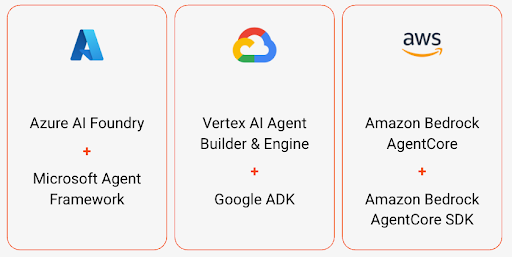
Overview of Managed Agents Solutions
These platforms do more than just host your agent or wrap model calls. They come with a lot of functionality baked in, like session handling, memory, tool execution, tracing, evaluation, and governance. In other words, much of the plumbing is already taken care of. That’s very different from building a custom agent from scratch. In that case, you usually start with a raw model API and build everything around it yourself: storing conversations, coordinating tools, tracing and debugging behavior, evaluating outputs, and enforcing guardrails. This gives you more control, but it also means more operational overhead.
The example below shows a simple agent built using Google’s ADK on Vertex AI. With relatively little application code, you get session management, long-term memory, tool execution, tracing, and logging out of the box — without having to design or deploy that infrastructure yourself.
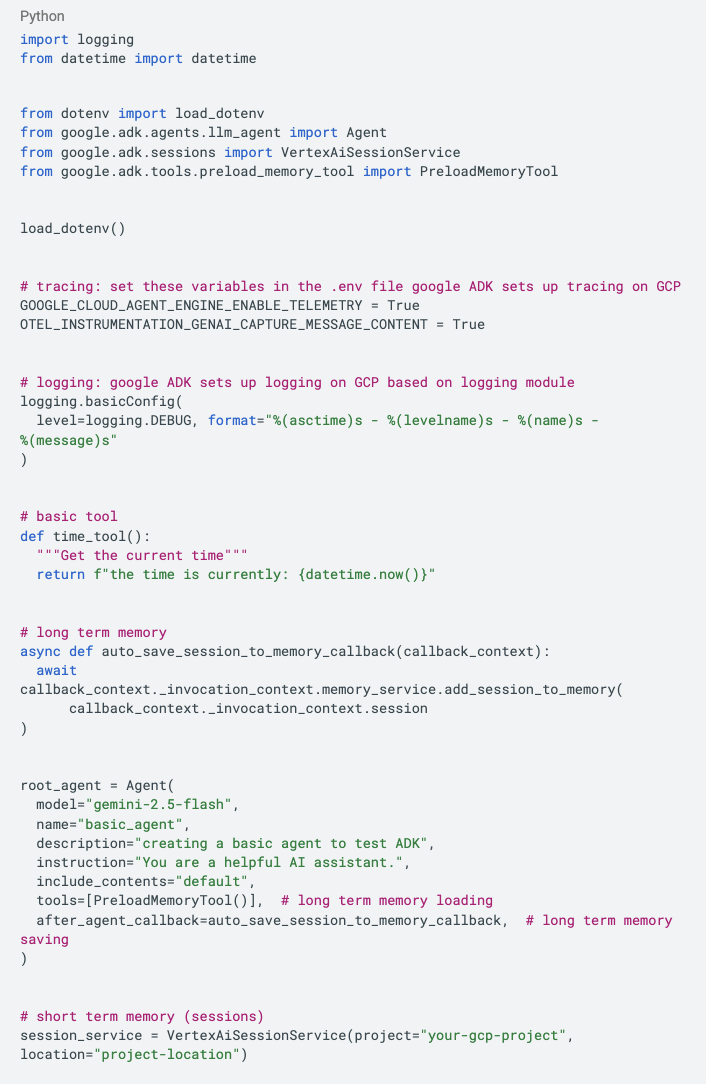
Code example of a managed AI agent built with Google ADK on Vertex AI, demonstrating session management, memory, and tool execution.
This is representative of what “managed” means in practice: less time deploying and setting up infrastructure and more time focussing on the agent logic itself.
Where MAS win
The main advantage of managed agent solutions is speed. Things like session handling, tracing, logging, simple tools, and basic evaluation can be turned on in minutes instead of taking days to build. For teams where getting to production fast really matters, especially when deploying generative AI into business processes, that alone can be a deciding factor.
They also work especially well in cloud-native environments. Beyond generic tools like web search or code execution, these platforms plug directly into their own cloud ecosystems. Services such as Azure AI Search, Microsoft Fabric, BigQuery, or Vertex AI Search can be used as agent tools without extra glue code. If your organization is already committed to a specific cloud, this kind of tight integration makes deployment much faster.
Finally, managed agent solutions give you a baseline level of governance that’s hard to recreate quickly with a custom setup. In addition to model-level safety, they usually include protections against prompt injection, PII filtering, content moderation, and block lists. These controls are easy to ignore early on, but they become essential once agents are exposed to real users and real data.
Where custom solutions win
That said, custom agent setups still make more sense for more complex AI systems and complicated multi-agent systems, and managed platforms do have gaps. Observability is one of them. The built-in tracing these platforms offer has come a long way and works fine for basic debugging and monitoring. But dedicated tools like Langfuse still go much deeper — especially when it comes to understanding costs, separating environments, managing prompt versions, filtering runs, or tracing across multiple clouds. For enterprise use cases, that extra visibility often matters.
Evaluation is another area where the limits show. Managed platforms support structured evaluations and some standard metrics, which is a big improvement over manual or ad hoc testing. But as soon as teams need domain-specific metrics or detailed retrieval evaluation, they usually end up building their own evaluation pipelines anyway.
Cost is often the final deciding factor. Pricing for managed agent platforms is intentionally made complex, which makes long-term cost planning and cost control difficult. With custom solutions, teams have much clearer visibility and control over what they’re spending.
Finally, there’s portability and workflow complexity. Managed agent platforms are tightly tied to a specific cloud provider and its abstractions. For long-lived systems, multi-cloud setups, or highly customized agent workflows with complex routing and coordination, tight coupling can become a limitation. In those cases, custom solutions tend to offer the flexibility needed to grow and adapt over time.
How to Decide Between Managed and Custom Agent Solutions
Managed agent solutions are a good default when speed, tight cloud integration, and built-in governance and visibility matter more than flexibility or cost. Custom solutions tend to be a better fit for hybrid-cloud setups or for more experimental use cases that go beyond standard conversational agents.
A growing middle ground is the hybrid AI approach, where teams start with a managed platform and replace selected components like governance, tracing, or logging. This enables greater control and cost efficiency without rebuilding the entire system, and is increasingly common in agentic AI architectures that combine managed services with custom components.
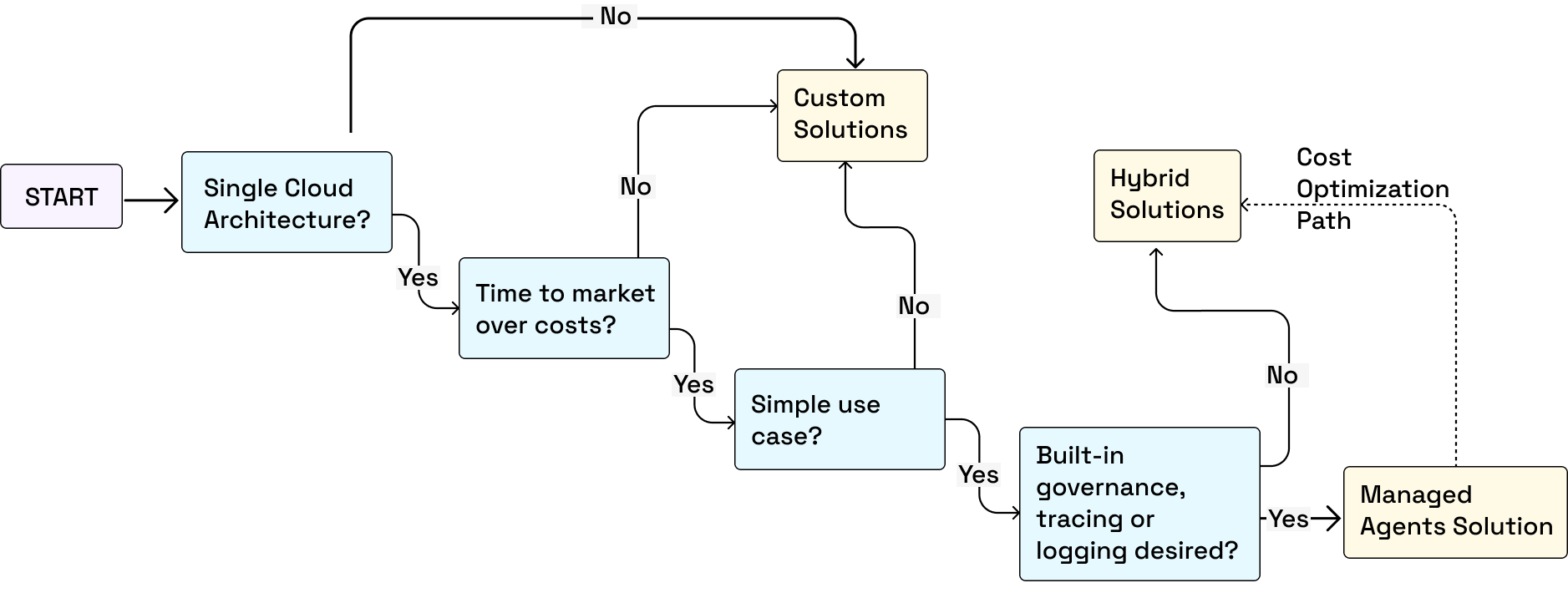
Decision Flowchart
Still not sure? Start with managed agent solutions and progressively replace individual components.
Conclusion
Managed Agent Solutions are moving fast. What felt experimental not long ago is now solid enough for production in many simple to moderately complex use cases. They remove a lot of friction, bake in common best practices, and make agent-based systems accessible to more teams. Custom solutions aren’t going away, but their role is narrowing. They’re increasingly reserved for the harder, more complex systems where managed platforms start to hit their limits. In 2026, the question is not “Can managed agent solutions be used in production?” It is “Do they fit our use case?”