
Executive Summary
AI-native engineering promises faster delivery, but speed alone does not guarantee quality.
As AI-generated code increases developer velocity, many teams experience new bottlenecks around code reviews, system ownership, and shared understanding. Senior engineers are increasingly burdened with review overload, while junior engineers risk shipping code they cannot fully explain.
In enterprise environments, balancing speed and quality requires deliberate intent, visible context, and clear ownership. Teams that succeed treat AI as an accelerator within a disciplined engineering process—not as a replacement for decision-making.
This article explores the hidden costs of unchecked velocity in AI-native engineering and outlines practical principles for scaling safely without sacrificing code quality or long-term maintainability.
What We’re Seeing in Practice
Everyone is talking about AI-powered development. If you listen to the hype, we’re all supposed to be 10x more productive by now, shipping code at the speed of thought.
At ML6, we’ve been living and breathing AI-native engineering for a while now. And while we’ve seen incredible gains in velocity, we’ve also hit some very real — and very human — roadblocks.
Here’s the thing: AI generates code at the speed of light, but understanding it still moves at the speed of thought.
If you just let the AI run wild, you don’t get a finished product. You get a Review Overload. You get a bottleneck that puts massive pressure on your senior engineers and leaves your juniors in the dark.
The Hidden Cost of Speed in AI-Generated Code
Leaning heavily into AI to “move fast” often results in senior tech leads becoming overwhelmed. Because they are ultimately responsible for quality and security, they feel a deep responsibility to safeguard the system. Instead of coding, they end up acting as “human compilers” for a mountain of AI-generated Pull Requests — spending more time reverse-engineering the AI’s logic than they would have spent building the feature themselves.
The problem isn’t a lack of effort; it’s a lack of alignment. The velocity is there, but the shared context is missing.
When you blindly generate a solution, you lose the “why” behind the code. Without that “why,” the review process becomes a circular, exhausting battle. Seniors find themselves constantly challenging implementation choices, only to realize the answers simply aren’t there — the developer can’t explain the trade-offs because they never made them. This forces the reviewer to stop being a mentor and start being a detective, reverse-engineering the AI’s “logic” just to ensure the system won’t break.
Friction Points in AI-Native Software Development Teams
AI-native engineering affects everyone on a project team differently. To make it work, you have to acknowledge the friction each role feels.
1. Junior Engineers: Learning vs. Generating
For juniors, AI provides an incredible velocity jump. Historically, a significant part of the learning process was “figuring things out” — the slow, often painful friction of wrestling with documentation and syntax to understand how a system works. AI removes this barrier, allowing you to bridge the gap between requirements and execution almost instantly.
However, this creates a dangerous Expectation Gap. Juniors often think their primary value lies in the volume of code they produce. But in a professional engineering environment, writing code is just the result of other efforts. What we actually expect from juniors isn’t raw output — it’s Building Knowledge.
This speed comes with a hidden cost: Knowledge Atrophy. If you “blindly generate” code, you skip the mental struggle that builds deep understanding. It becomes dangerously easy to fall into the “superficial comprehension” trap, pushing code that works but that you can’t explain in a technical review. Your job isn’t just to ship code; it’s to ship proof of engineering rigor, which starts with your own understanding of every line you commit.
2. Senior Engineers: The Shift in High-Impact Work
Seniors remain the architects and builders of the system. However, in an AI-native world, their highest leverage shifts. While they still write code, an increasing amount of their impact moves toward architecting systems, mentoring the team, and ensuring rigorous output verification.
Historically, the “why” was baked into the code because a human had to make every decision while writing it line by line. You couldn’t write the code without making the trade-offs. AI changes this: it allows you to generate code without making those decisions. This makes “challenging the reasoning” more critical than ever. At ML6, we don’t treat this as a new concept — it has always been the hallmark of a great engineer. But in an AI-native world, we are doubling down: it is no longer enough to check if code works; the “why” must be explicitly defensible because the AI isn’t going to make those trade-offs for you.
However, without the right discipline, this leverage collapses into a Review Overload. AI generates code faster than a human can safely review it, threatening to turn seniors into “human compilers” for a mountain of unverified code. It leads to context fatigue, where tech leads spend more time reverse-engineering AI logic than they do on actual engineering or mentorship.
3. Project Managers: The 90% Completion Illusion
For PMs, AI-native engineering changes the rhythm of a project. It’s faster, but the “finish line” becomes harder to see.
For PMs, AI-native engineering changes the rhythm of a project. It unlocks faster Alpha cycles, allowing you to put a “lovable product” in front of clients much earlier and iterate based on real feedback.
But this speed creates a dangerous optical illusion known as the “Productionization Gap”. Because we now often “Work Backward” (Interface → Logic → Foundation), a working UI creates the false impression that the project is 90% done. In reality, the hard foundational work (cloud, logging, databases) hasn’t even started.
At ML6, we’ve found that productionizing a UI created through “vibe coding” — where the interface is polished but the underlying architecture is neglected — often requires significant refactoring. Proactively managing this gap is essential to ensure that an early prototype can successfully evolve into a scalable solution without being weighed down by unexpected technical debt.
Our Approach: The ML6 Way of Working
So, how do we handle this? We don’t just “use AI.” We use it deliberately, applying a triad of explicit commitments that prioritize quality engineering over raw output.
1. Intent-First Development
We ruthlessly split intent from action. Before a single line of code is generated, the engineer must align with the team on the “why” and the trade-offs of the chosen solution. This upfront design isn’t a heavy bureaucratic process; it’s about making the decision-making process visible. By the time we start prompting, the implementation becomes a predictable result of a well-defined plan.
2. Building a “PaperTrail” of Context
The biggest risk in AI-native development is the “Black Box” effect — where critical context is lost in ephemeral LLM chats, turning your team into an “extra lossy system.”
We move this from private chats to “Visible Intent.” We use lightweight, version-controlled context files (like agent.md or README.md) to define the spec before we prompt. This is a practical form of Spec-Driven Development (SDD) that ensures the “why” lives alongside the code. It turns peer review into a smooth checklist where we review the intent first, not just the implementation.
3. Absolute Ownership
We operate on a principle of Absolute Ownership: You are responsible for every line of code you commit, regardless of who (or what) generated it. There is no such thing as “AI-generated throwaway code” at ML6. If you can’t explain it and defend it, you can’t ship it. This accountability is the ultimate antidote to the “vibe coding” trend.
4. Business-Driven Testing
We believe that Testing is Proof. However, we’ve learned to avoid AI-generated “rubbish” tests that only serve to inflate coverage metrics. Instead, we focus on tests driven by business requirements. AI can write the test code, but the intent of the test must come from a deep understanding of the client’s problem. If you haven’t proven it works, you haven’t finished the job.
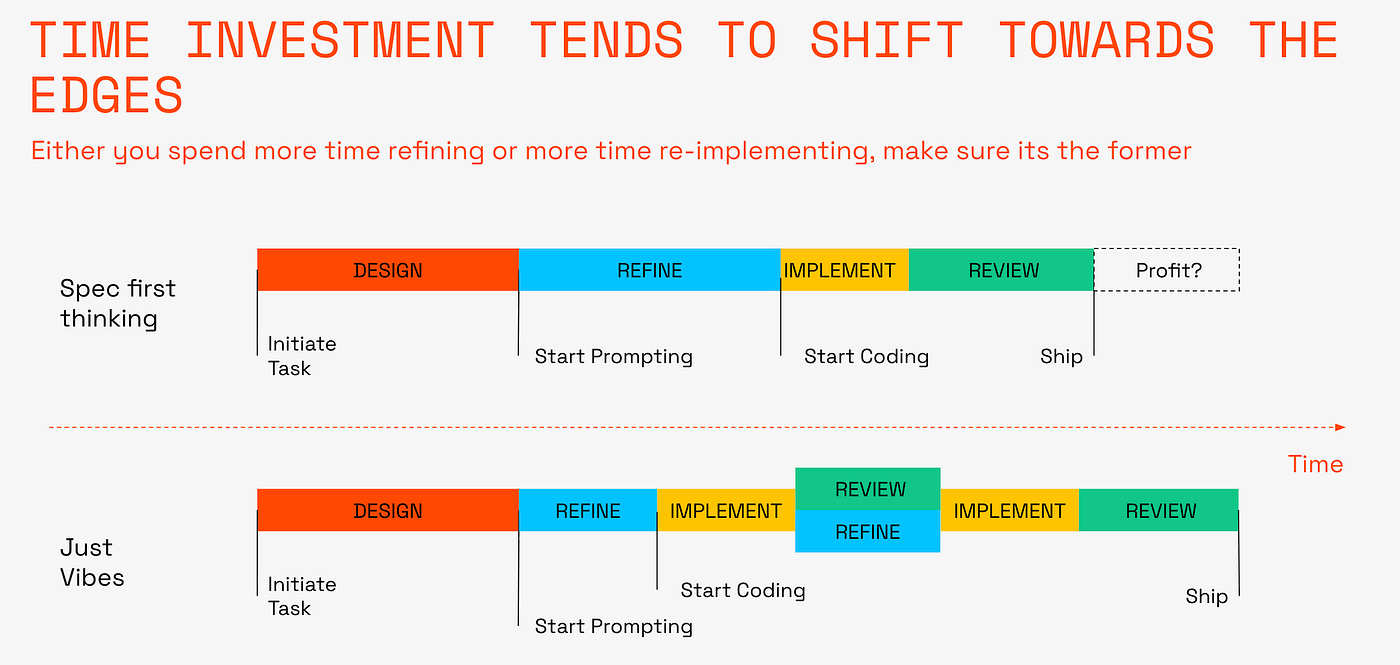
Investing time in defining the “why” (the edges) saves time during review and refinement.
The New Shape of the Team
AI isn’t just changing how we code; it’s changing who does what. The strict walls between “Technical” and “Functional” roles are crumbling.
In a traditional “Software Factory” model, a functional analyst writes a ticket, hands it to a developer, who hands it to a QA. It’s a linear assembly line where context is lost at every handover.
In an AI-Native “Software Studio,” everyone moves closer to the center:
- Functional profiles become more technical: With natural language prompting, functional analysts can now prototype features, validate logic, and even “touch” the code to verify their requirements.
- Technical profiles become more functional: Because the AI handles the syntax, engineers must spend their time understanding the business intent. If you don’t understand the “Why,” you can’t guide the AI to the right “How.”
This creates a cross-pollinated team where the focus isn’t on handing off tickets, but on collaborative design.
Building with Eyes Wide Open
AI-native engineering is the new normal. It makes us faster, and it allows us to bridge the gap between technical and functional roles in ways we never thought possible.
But it’s not a magic button. It requires a more disciplined, human approach to design and quality control than ever before.
At ML6, we’re not just chasing the highest velocity. We’re building a way of working that ensures we ship stable, safe, and enterprise-grade outcomes — not just AI-generated noise. Quality engineering isn’t an afterthought for us; it’s the core of how we build.
Interested in how we can help your team navigate the AI-native shift safely? Let’s talk.