

Executive Summary
Traditional, linear supply chains are no longer viable in a world defined by geopolitical volatility, climate uncertainty, and hyper-fast innovation. Organizations must transition from reactive ‘firefighting’ to a predictive model of operational intelligence to survive. By leveraging AI-driven demand sensing, organizations can reduce forecast errors by up to 50% and reduce lost sales due to product unavailability by up to 65%, directly protecting margins and reducing the ‘reactive tax’ of emergency logistics. We outline a Sense-to-Learn loop that replaces static planning with a continuous cycle of real-time data ingestion, anomaly detection, and automated prescription. This shift redefines the human element, moving planners from manual data reconciliation to strategic orchestration. Ultimately, the future of global trade belongs to self-healing supply chains that anticipate disruptions before they occur. In a volatile market, the winner is not the one who reacts fastest, but the one who sees the wave before it hits.
Why Traditional Supply Chains No Longer Work
In the traditional era, supply chains were built for linear stability. Today, that world is gone. It has been replaced by a world shaped by geopolitical instability, climate uncertainty, stricter sustainability rules, and rapidly shifting demand. This shift has rendered legacy planning processes - which often act like driving a car while looking only at the rearview mirror - completely obsolete. We are entering a new era of operational intelligence where higher flexibility is no longer an advantage, but a requirement. In this landscape, the supply chain is no longer a series of reactive links, it is a synchronized system where real-time data flows directly into automated adjustments. For the modern enterprise, this is a mandate to move from firefighting to anticipation.
The Anchor: It Starts with Demand
The predictive revolution does not require overcoming every hurdle at once. It begins by getting the demand forecast right. Yesterday’s patterns no longer predict tomorrow’s reality. By utilizing AI-driven demand sensing, organizations transition to real-time awareness.
This creates a powerful cascade effect. Accurately predicting sales demand is the master key that unlocks lost sales insights by identifying demand never met due to stockouts. It also allows for stock optimization (with industry research suggesting potential reductions of buffer inventory of 20 to 30 percent) while maintaining high service levels. Most importantly, it enables a dynamic strategy where signals inform pricing and assortment extensions in real time.
Case in Point: PepsiCo moved beyond historical averages by leveraging AI to predict daily demand for snacks at individual sales points. Rather than relying solely on past sales data, the system integrated a broad range of demand signals to improve forecasting precision. According to a published case study by TAZI AI, the implementation achieved 98% prediction accuracy for 86% of products, reduced truck stock-out rates by 4%, and increased average order size by 3.1%, while optimizing truck loading for thousands of drivers.
The Architecture of Predictive Control
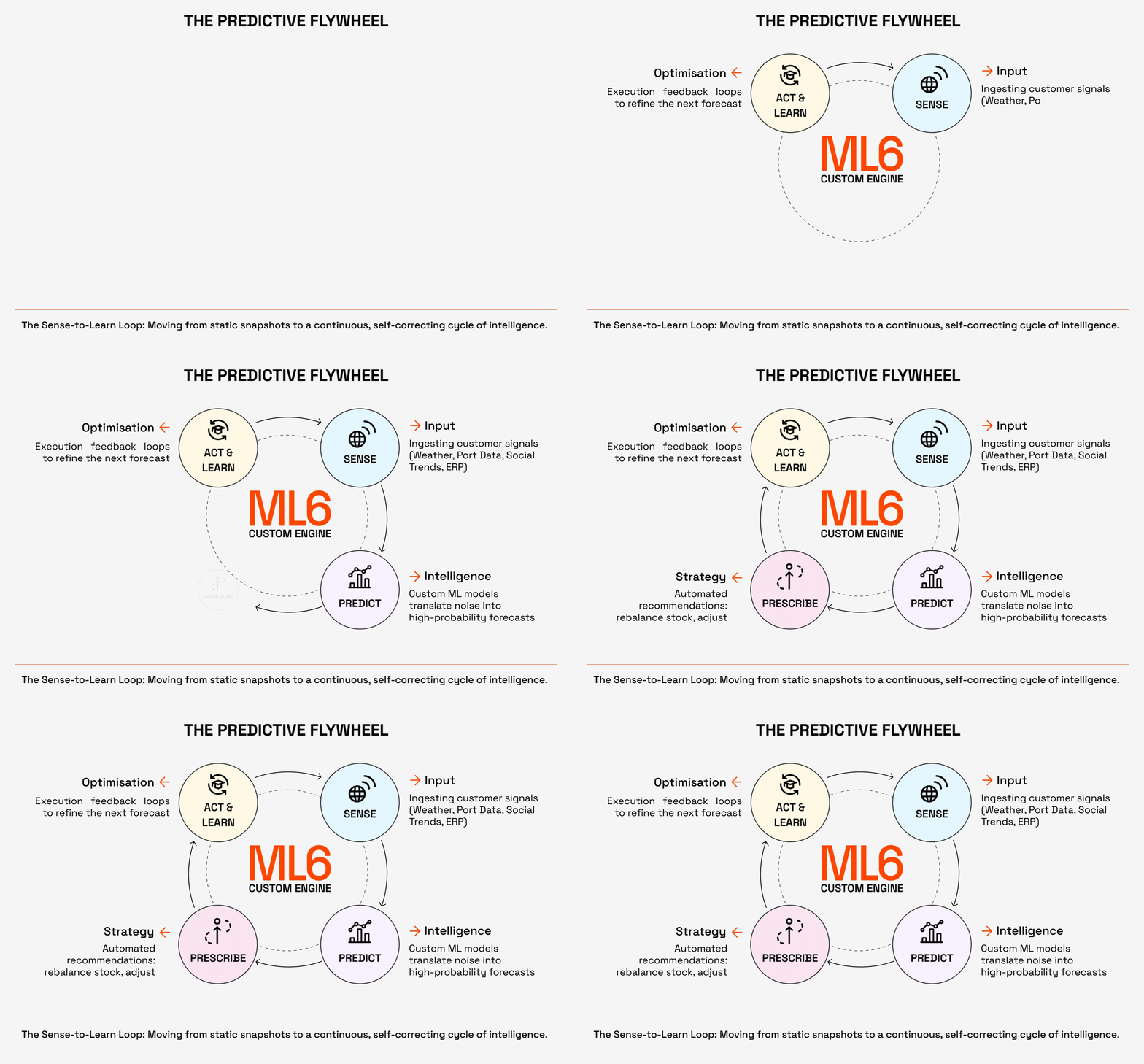
To achieve true clarity, enterprises must adopt a "Sense-to-Learn" loop. This replaces static monthly plans with a continuous and adaptive cycle.
- Sense: AI ingests ‘noise’ from the outside world, such as weather patterns, port congestion, and social sentiment. It turns these raw signals into structured intelligence.
- Predict: Machine learning models infer what is likely to happen next. This allows the system to spot anomalies before they escalate into crises.
- Prescribe: The system does not just warn of a delay. It suggests specific solutions, such as rerouting shipments or reallocating inventory across the network.
- Act & Learn: Planners use AI copilots to make decisions in minutes that once took days. Meanwhile, the model retrains itself on every outcome to improve future accuracy.
Unlike rigid, off-the-shelf software that forces your data into a pre-packaged box, a true predictive engine requires an engineering-first approach. At ML6, we build custom models tailored to your specific data architecture. This flexibility allows us to ingest and weigh unique, ‘noisy’ signals that standard tools often ignore. By tailoring the model to your data, rather than the other way around, we turn the Sense-to-Learn loop into a precise competitive advantage.
Consider a scenario in the printing industry: if planners rely solely on historical orders, they may miss a poor wine harvest in France that will soon reduce demand for wine labels. By integrating external agricultural data, organizations move from surprise to preparation.
The Human Element: Process Over Data
Before investing in AI, leaders must ask a critical question:
How well do you have your current S&OP process under control?
Often, chaos is a process problem disguised as a data problem. AI is not a black box designed to replace human judgment. It is a co-pilot intended to augment it. To succeed, organizations should focus on a Data Minimum Viable Product. You do not need a perfect data lake to start.
Instead, begin with a high-value corridor where demand is most volatile to prove the AI's efficacy before scaling. The goal is to move humans toward strategic orchestration while machines handle the analytical heavy lifting.
In many organizations, planners can spend upwards of 70% of their week manually reconciling spreadsheets to determine safety stock for hundreds of SKUs, while AI could identify the three specific products at risk of a stockout due to an upcoming port strike.
The human’s role shifts from data gatherer to problem solver, focusing their expertise on negotiating alternative logistics or shifting promotional spend before the disruption even occurs.
The Measurable Impact of Anticipation
The shift to predictive control is not theoretical. It is increasingly quantifiable.
According to McKinsey research, applying AI-driven forecasting to supply chain management can reduce forecast errors by 20 to 50 percent. It can also reduce lost sales and product unavailability by up to 65 percent, directly protecting margins. Warehousing costs may fall by 5 to 10 percent, and administrative costs by 25 to 40 percent.
There is also a significant cost to inaction, as reactive models often lead to premium emergency freight and avoidable supply chain inefficiencies. Companies that stick to reactive models frequently pay a ‘reactive tax’, such as expedited freight costs that can be two to four times higher than planned transportation.
In an era of fragmented demand, predictive control is the only way to avoid these costs while capturing market share from competitors who cannot keep products on the shelf.
Conclusion
We are moving toward self-healing supply chains. These are systems that automatically detect issues and adjust plans to rebalance inventory with minimal intervention.
The biggest failures do not come from bad decisions. They come from decisions made too late. In a world of volatility, you do not win by reacting faster. You win by seeing the wave before it hits. The era of surprise is over.