.jpeg?width=154&height=192&name=Tim%20Rood%203%20(2).jpeg)
Executive summary
The scale and speed of social media have made manual monitoring and static dashboards too slow and inflexible, creating a costly latency tax through missed opportunities, slower competitive responses, and delayed crisis management. Agentic AI addresses this gap by continuously analyzing multimodal signals across text, video, and audio, identifying emerging trends and brand anomalies, and converting large volumes of unstructured data into actionable workflows. By significantly reducing time-to-insight and time-to-action, these systems enable enterprises to move from passive observation to proactive marketing execution while keeping creative directors and business leaders in control of strategic interpretation, approvals, and final decisions.
Modern Marketing: Scale, Speed, and Chaos
What does a chatbot obsessed with goblin folklore have in common with a viral skincare trend turned €1 billion brand and a fashion runway operating at machine speed? None of them would have surfaced on a traditional marketing dashboard.
Market-defining signals don't present themselves as clear as day; they hide in a chaotic, daily firehose of millions of social media posts. Whether you want to catch a subtle system bug before it escalates into a PR nightmare or shrink design production cycles from weeks to days, the competitive edge belongs to those who act autonomously. It’s time to move past passive observation and kick off the era of agentic action.
Social media listening has evolved from basic keyword tracking into a core enterprise intelligence engine. With over 5.2 billion social media users worldwide generating billions of unstructured posts daily, identifying the right signals has become a structural challenge. For enterprise marketing operations, this commercial urgency is defined by massive visibility and routing friction rather than simple text counts:
- The Audio-Visual Blind Spot: Traditional enterprise social listening tools rely heavily on text metadata, creating a catastrophic "visual blind spot." Real-time data audits reveal that up to 80% of brand-bearing images carry no text reference to the brand, while roughly 70% of TikTok brand conversations are entirely untagged in the text caption. If your system cannot listen to the audio or read the video frames, the majority of your brand mentions are lost.
- The Interception Latency Gap: The structural failure point for global brands is no longer data collection, but routing latency. High-velocity modern platforms have accelerated the speed of conversation, and 70% of consumers now expect brands to respond to social mentions within 24 hours (with 40% expecting a response within the hour). Collecting raw sentiment data without the autonomous operational capability to route those insights to PR or product teams immediately is when enterprises lose their window to act.
- The Enterprise Integration Deficit: True strategic value requires moving beyond isolated marketing silos. While 93% of company executives agree that social media data should be a primary source of business intelligence, an alarming 70% admit it remains completely underutilized within their organizations. Modern operations demand that social intelligence be autonomously integrated directly into core CRM and BI pipelines to connect cultural momentum to hard revenue outcomes.
For brand leaders, the question is no longer whether to monitor these digital signals, but how to process and route them across enterprise systems at scale before the competitive window closes.
In this blog post, we’ll see how agentic social listening systems help organizations adapt to a rapidly evolving marketing landscape. First, we’ll analyze their success across several enterprise use cases. Then, we highlight why established legacy solutions—such as dashboards—lack the flexibility, speed, and rigor required in the emerging media landscape. Finally, we look under the hood of Agentic AI to show exactly how autonomous workflows function as proactive marketing assistants.
Real-World Impact: Turning Unexpected Social Trends Into Wins
Case 1: The Goblinification of ChatGPT
Starting with GPT‑5.1, ChatGPT users began observing a rather strange habit in the chatbot: they increasingly mentioned goblins, gremlins, and other creatures in their metaphors. Some liked ‘the goblinification of ChatGPT’, and considered it a cute gimmick. The overwhelming majority of users, however, responded negatively to the subtly creeping regression, indicating that it hindered their user experience when every other metaphor was related to goblins and gremlins.

One of the reasons this popped up on OpenAI’s radar is because they, like most enterprises, aim to continuously monitor social media for alarming signals or regression in performance, user experience, or bugs. System regressions are subtle, and it’s almost impossible to completely prevent them through internal engineering guardrails. They detect these signals early, giving them a head start in a thorough investigation and mitigation approach. If they wouldn’t, problems would reach the surface once the goblinification had already become a serious issue—and the investigation still needs to start.
Mature software is monitored extensively for regression, drift from its original behavior, and performance skew. However, even the best model monitoring systems simply can’t capture all possible issues. End users express their user experience for free on social media. For example, the first signs of the goblinification of ChatGPT surfaced on obscure Reddit threads—far beyond the scope of internal monitoring systems.
OpenAI created a very interesting post about the discovery, cause, and mitigation of this goblin-frenzy ChatGPT phase, and managed to mitigate the issues effectively before they truly got out of hand. If you’re interested in giving it a read, you can do so here.
Case 2: Vaseline Verified
The digital landscape is flooded with unregulated lifestyle advice, yet millions of consumers treat social feeds as their primary source of health and wellness information. Rather than retreating from this chaotic chatter, Unilever—the brand behind Vaseline—leaned directly into it. Alongside partners Ogilvy and Mindshare, they launched 'Vaseline Verified' to actively intercept viral skincare trends and claim brand authority over them.
Their campaign concept was surprisingly simple: find a selection of trending ‘beauty hacks’ using Vaseline and test them in practice. Lean into the hype and be transparent on the results. It was a huge hit.
But how did they find the right reels that ‘apply Vaseline as a beauty routine’? Cues are scattered in hashtags, visuals, and spoken phrases—an unstructured mess that requires serious tools to structure and to parse. Finding the diamonds in the rough required a sophisticated AI pipeline. So Unilever built one.
Their investment was worth it: their ‘Vaseline Verified’ social media marketing campaign received the Titanium award at the Cannes International Festival of Creativity and two Grand Prix Wins, turning Vaseline into one of Unilever’s €1 billion Power Brands in 2024, achieving double-digit growth through the year. They’re proving that willingness to adapt to the modern-day age marketing pays off.
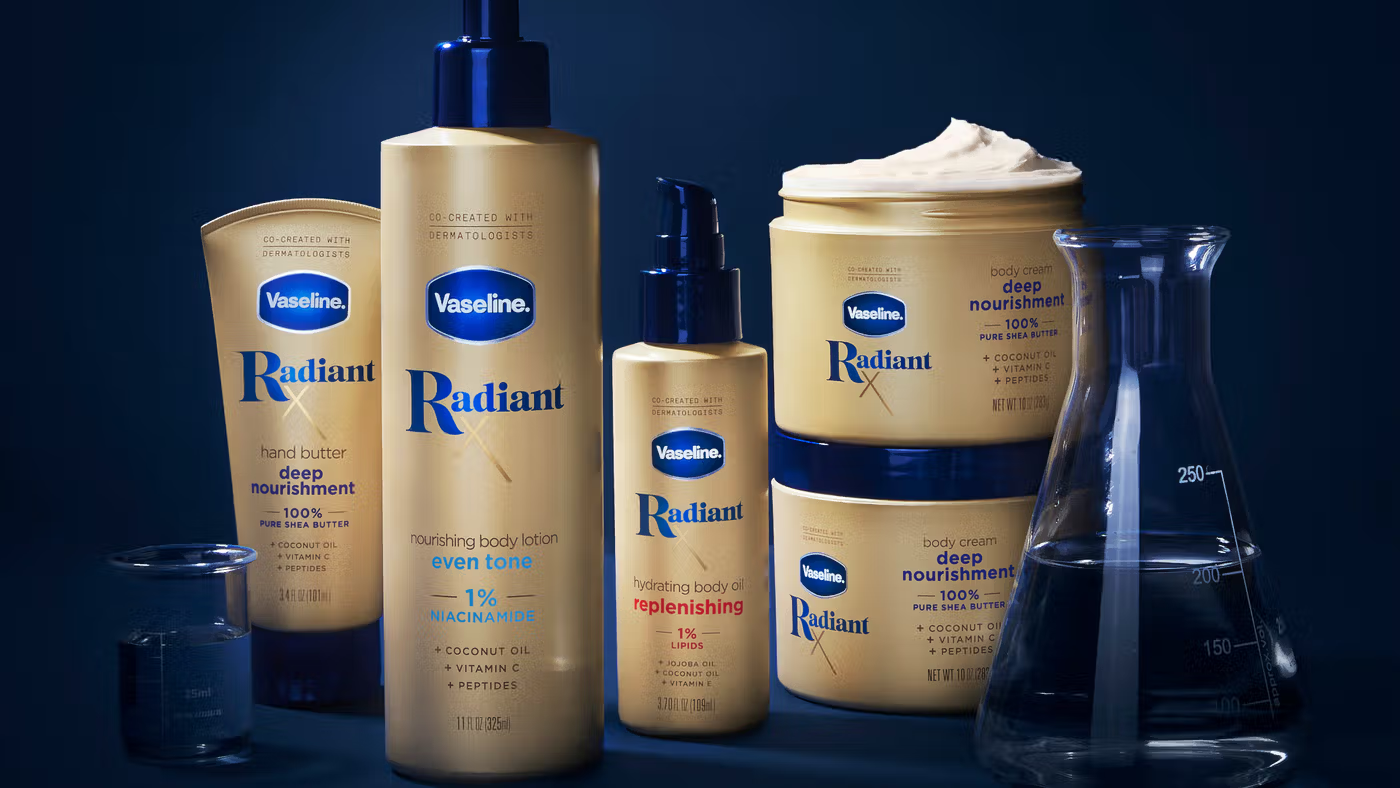
Unsurprisingly, they’ve continued their track of AI-native marketing. A more recent campaign called ‘Vaseline Originals’ turns viral beauty hacks into real products and leans on an equally sophisticated AI workflow.
Unilever's CEO even announced plans to shift its advertising budget toward social media, recognizing that authentic user conversations now drive more trust than traditional broadcasts. As a Unilever executive put it, brands must learn to engage on social media "without killing the party."
Case 3: Zalando’s forward-thinking product development
If anything moves fast, it’s fast fashion. Matthias Haase, Zalando’s VP of Content Solutions, discusses Zalando's AI-native way of working in a two-part series on the company's website. They noticed the market changed, became faster and more dynamic, and their traditional production workflows just couldn't keep up with that pace. Generative AI was the solution to that bottleneck.
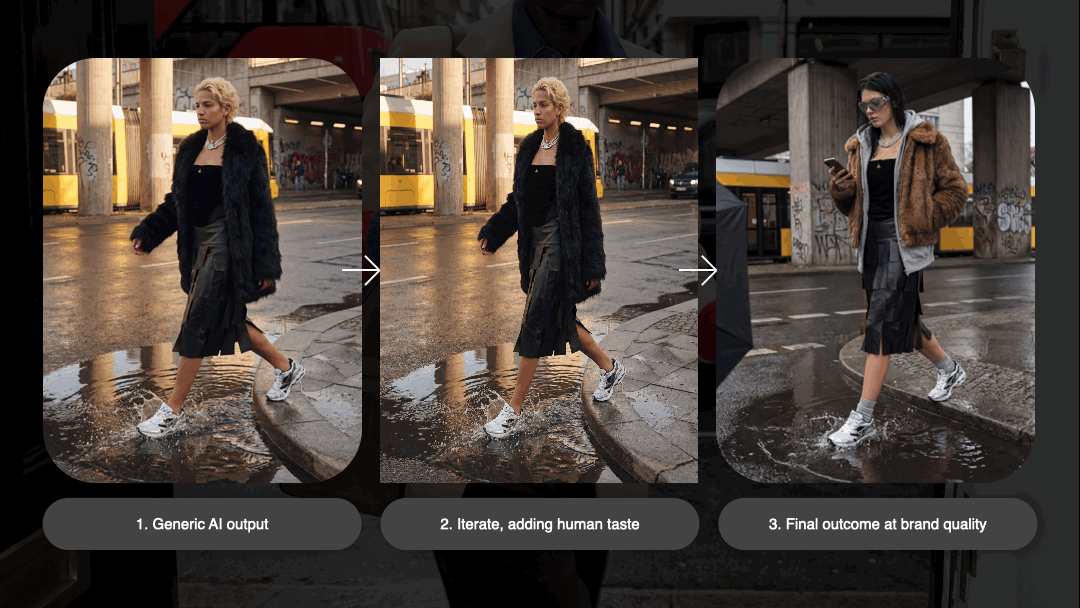
They managed to move from a rigid, weeks-long production calendar to a system that can go from spotting a trend to publishing it in a few days, and they adopted a clear AI-native approach. With 50+ million customers on their platform, they have a unique signal—they can see search spikes, browsing shifts, and sales patterns in real time. When something starts moving on Zalando, they know about it immediately. But how does Zalando turn this into actionable set-ups for new campaigns?
Their solution is clever: they validate their internal signals with their custom-built social listening tool, which analyzes media coverage and creator content to confirm whether a trend has broader cultural momentum. Once they have the trend, the engine can even generate a simple prompt for the initial visualization. But that’s just the base layer. Their creative team still defines the taste and the final vibe.
In a real photoshoot, messy, human details make an image feel authentic. They aim to maintain the subtle textures and real-life lighting that make content feel authentic.
We guide our AI to keep messy, human details and make ideas authentic—the subtle textures and real-life lighting that make our content feel like a human moment rather than robotic perfection. AI is just a high-speed tool that helps our creators get there.
- Matthias Haase
Moving Beyond the Dashboard Era
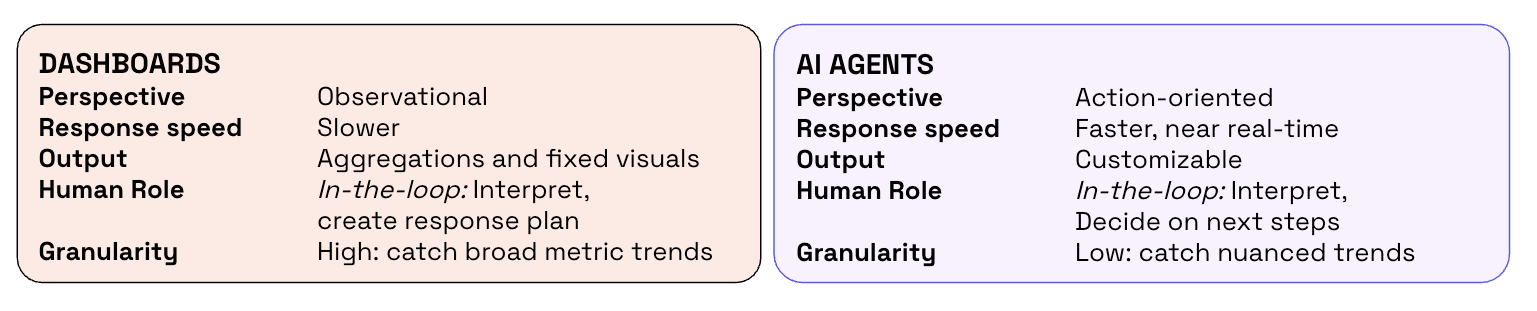
We’re living in days of huge market potential. Many enterprises already incorporate some form of social listening in their workflow, but more often than not, they rely on outdated, cumbersome, or simply insufficient methods: the wrong tool for the right goal. While real-time dashboards remain a widespread selection for social listening, they frequently fall short of current requirements—a gap that agentic workflows are uniquely positioned to fill.
First, agent workflows drastically cut the time-to-action, turning potential crises into preemptive actions. For instance, a traditional dashboard might only flag a metric spike on a new product rollout; a human team would then spend hours investigating. By contrast, an AI agent can immediately read the underlying context, isolate a specific "greenwashing" accusation, cross-reference it against your corporate compliance guidelines, and draft a pre-approved response for immediate review.
Second, agents move beyond strict metrics to detect granular trends. Where dashboards rely on keyword counts and rigid data models, agents are designed to handle nuance, such as identifying subtle shifts in sentiment, emerging aesthetic movements, or context-specific humor that a passive dashboard completely misses.
Finally, this shift liberates creative directors and marketing managers. Instead of being bogged down in "surfacing issues," they step into a purely strategic role, focusing their expertise on the final decision-making and strategic interpretation of high-value, actionable outputs generated by the agent.
Bridging the Gap Between Insight and Action
ML6 specializes in the design, deployment, and delivery of enterprise-grade systems leveraging agentic AI. Moreover, we invest in understanding where the market moves and see that the most significant advancements in this space stem from expanding the operational reach and decision-making capabilities of these autonomous agents.
OpenClaw serves as a compelling proof of concept, demonstrating an agent capable of navigating diverse facets of digital interaction. My colleague Niels Rogge wrote a great blog post about OpenClaw. As he put it, “the success of OpenClaw is a clear signal that shows we are entering the ‘Action Era’ of agents”.
While complete autonomy across all workflows may not be advisable for every organization, the significant industry attention garnered by OpenClaw highlights a clear shift toward actionable AI. Implementing such systems, however, requires a disciplined approach and deep technical expertise.
Clients tend to think the real challenge is technology, but in practice, building mature infrastructure and agent guardrails is much more challenging than getting an agent to do what it needs to do. In fact, with the right infra and guardrails, agent systems tend to strengthen existing workflows. It’s a successful move used by Unilever, OpenAI, and Zalando that paid off.
What this means for Enterprises
In the modern age, enterprises can do much more than rely on traditional dashboards alone. At ML6, we can help you productionize agentic systems that help you keep up. We build custom internal work assistants—production-grade, agentic systems tailored to specific business workflows such as procurement, marketing, and operations. While systems like OpenClaw are a proof of concept for what's possible, our job is to make it real, reliable, and enterprise-ready.
Beyond individual agents, we help organizations scale these capabilities through our AI Native Engineering offering. This structured program bridges the gap between fragmented experimentation and enterprise-grade delivery.
Whether you're exploring what autonomous agents could mean for your organization, trying to move a prototype into production, or need to build the governance layer that makes agentic AI safe to deploy, we can help. If you're exploring how autonomous AI agents could create value within your organization, our team is happy to start the conversation.