

Executive summary
“Human-in-the-loop" has become the duct tape of AI governance, a single phrase covering four very different design choices: mandatory approval, continuous monitoring, ultimate authority, and pre-authorized autonomy. The piece argues that the interface between human and AI is not a UX layer but the relationship itself, and that serious design means picking the right mode per decision rather than per product, accounting for who is actually in the room, and building systems that can both mature over months and shift gears within a single day.
"Human-in-the-loop" has become the duct tape of AI governance. It is invoked in board meetings, written into procurement requirements, and printed on slide 14 of just about every AI strategy deck. Saying it once seems to settle the question of how human oversight will work.
It does not. The phrase has been stretched so far that it now covers four very different design choices, each with its own operational implications, failure modes, and trust requirements. Treating them as interchangeable is how organizations end up with systems that are supervised in theory, but unsupervised in practice.
This piece is about what we lose when "human-in-the-loop" becomes a catch-all, and what we get back when we treat the human-AI relationship as four distinct modes: deliberate design choices that are combinable and adjustable over time.
Design is how it works
Steve Jobs put the underlying point well: "Design is not just what it looks like and feels like. Design is how it works."
Most discussion of "the interface" treats it as a UX problem. It is not. The interface is the layer where the human and the AI meet. It determines what the human sees, what they are asked to do, how much they can influence the outcome, and how much they are expected to simply accept. That is not decoration. It is the relationship itself. In a real sense, the person designing the interface is making governance decisions, not screen decisions.
If the interface is the relationship, then the first question is not which controls go where. The first question is what kind of relationship this is supposed to be.
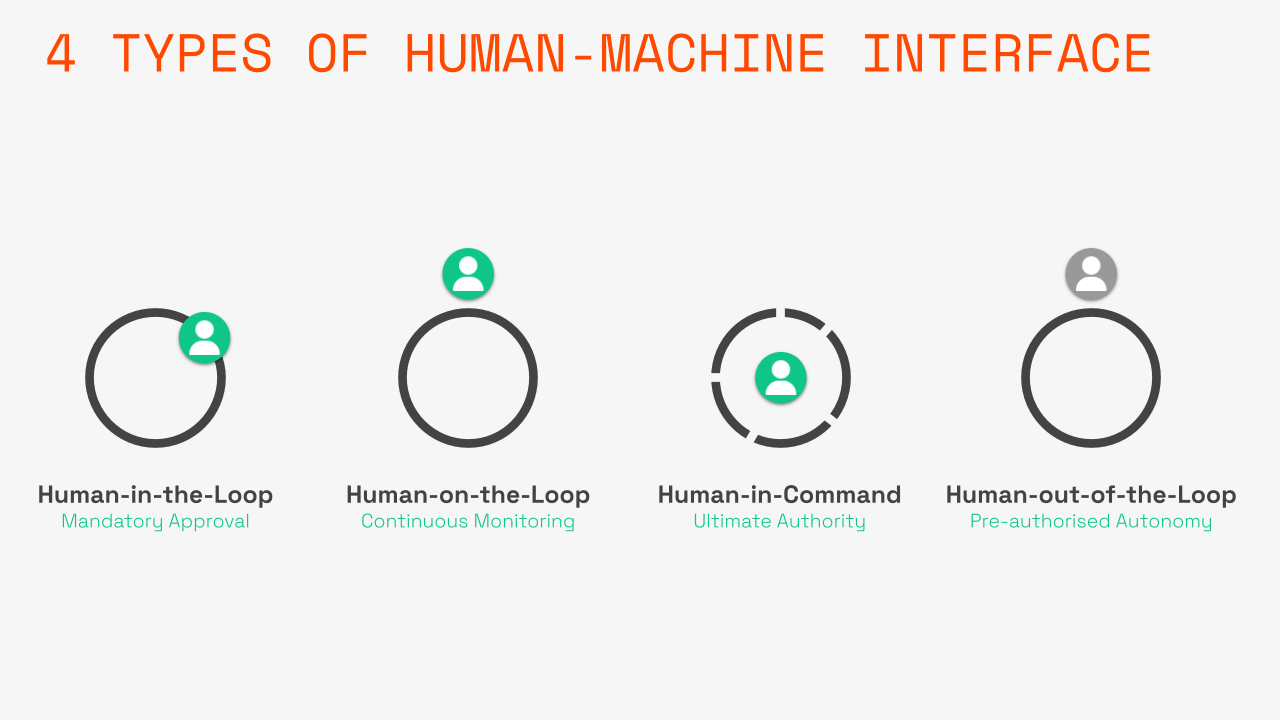
Four modes have emerged across the field, each describing a fundamentally different distribution of authority between the human and the system.
Human-in-the-loop (HITL): mandatory approval. The AI produces an output; a human reviews and signs off before anything takes effect. Nothing happens automatically. The human is the final gate.
Human-on-the-loop (HOTL): continuous monitoring. The AI operates autonomously, but a human watches in real time and retains the ability to intervene. The human is not approving each output, but they are never fully out of the picture.
Human-in-command (HIC): ultimate authority. This mode operates on two levels at once. Policy authority: humans define the goals, constraints, and boundaries within which the AI may act, and can revise them. Action authority: humans retain the ability to pause, override, or stop specific actions as they unfold.
Human-out-of-the-loop (HOOTL): pre-authorized autonomy. Humans define the policy in advance: the goal, the rules of engagement, the conditions that authorize action, the conditions that forbid it. Once the system starts, no real-time involvement is possible, by design or by environmental constraint. The trust work concentrates at the bookends: upstream in the policy, downstream in the review.
The Parenting Analogy
A useful way to hold these four in mind is to think about parenting a six-year-old.
Human-in-the-loop is sitting beside the child and checking every piece of homework before it gets handed in. The child does the work. Nothing goes to school without the adult reviewing it first.
Human-on-the-loop is watching the child play in the garden from the kitchen window. They have autonomy. You are not directing every move. But you are watching, and you will step in the moment something looks dangerous.
Human-in-command is standing beside the child while they help prepare dinner, knife in hand. You have set the rules: how to hold it, what to cut, how much pressure to use. You are present and watching. You can take the knife at any moment if something goes wrong. The child acts; you retain both the authority to define how and the authority to intervene when.
Human-out-of-the-loop is sending the same child to the supermarket on their own for the first time, to fetch a carton of eggs. Before they go, you have walked the route together, explained what to get, given them the right money, and told them what to do if they cannot find the eggs or if a stranger speaks to them. You have set the rules of engagement. Once they leave, you cannot reach them. You wait at home. When they return, you debrief: did it go to plan, was there anything they were not sure how to handle. What you learn shapes the next trip.
Four pictures, four kinds of involvement: reviewing, watching, co-acting, framing-and-reviewing-after. Each captures something true about what the human is actually doing.
Translated back into deployment, the same four show up clearly. HITL fits AI-assisted recruitment screening, where every score and summary is reviewed by a recruiter before it shapes a hiring decision. HOTL fits an AI quality control system on a production line, running continuously and alerting human operators only when something anomalous appears. HIC fits a surgical robot, where the surgeon defines the operating parameters, can halt at any moment, and the system executes within those bounds. HOOTL fits an autonomous underwater vehicle operating in contested waters where reliable real-time communication with a human operator is, by design assumption, unavailable.
How do you choose the right oversight mode?
So which mode is right for your use case? The first instinct most teams have, when they meet this question, is to choose one mode for the whole system: "This will be a human-in-the-loop product." That instinct is wrong. But before we get to why, three criteria should drive the choice for any single decision.
Scale. How many decisions of this kind need to be made, how fast, how often? Scale is a hard constraint. HITL becomes physically impossible above a certain volume. If a single decision type happens thousands of times an hour, mandatory approval is not a design option; it is a fiction. Scale sets the ceiling on how much human involvement is operationally achievable.
Stakes. What is the potential for harm if the AI is wrong, to individuals, to the organization, to society? How reversible are the outcomes? What is the regulatory exposure? And how epistemically reliable is the model: does it know when it is uncertain, or does it produce confident outputs regardless of the evidence underneath them? High stakes and low reversibility push toward greater human involvement, regardless of what scale permits.
Attention. This is the criterion most processes ignore, and increasingly the most consequential one. Where, realistically, can a human pay attention? Sometimes the constraint is cognitive: under time pressure or task saturation, the quality of oversight degrades rapidly, often without the person noticing. Sometimes it is environmental: deep-sea operations, deep-space probes, contested electromagnetic environments, and the timescales of certain financial and cyber-defense systems all make real-time involvement infeasible. An interface that theoretically gives humans control but in practice overwhelms their capacity to exercise it is not a trustworthy interface. It is a liability dressed as a safeguard.
If a human can meaningfully engage everywhere, you may be looking at HITL. If continuously but at a distance, HOTL. If at the policy level with intervention available, HIC. If only before and after, HOOTL.
One mode at a time, not one mode forever
The three criteria give you an answer for a single decision. They do not give you an answer for the system. A complex AI system, in practice, is almost never a single mode.
The recruitment screening tool described above operates as HITL on individual candidate decisions, but it might run as HOTL on aggregate fairness monitoring, and as HIC on the policy choices about which sources to include in the candidate pool. A dispatch system in a power utility might be HITL by default but escalate to HIC for high-risk overrides. A production quality control system might run HOTL during normal operation but revert to HITL when the model's confidence drops below a defined threshold.
Treating mode as a product-level decision rather than a decision-level one is one of the most common design failures in AI. The result is either a system that does not flex (and frustrates users) or one that flexes ad hoc (and confuses them).
Who participates in the relationship?
There is a second assumption hiding under most discussions of human oversight: one human, one AI. A single user, a single screen, a bilateral relationship. Call it the marriage model. Almost every cognitive bias diagnostic, every interface pattern, and every accountability framework in current use rests on it.
It is increasingly incomplete. Four configurations are now worth distinguishing.
One-to-one is the familiar default. The recruiter screens CVs. The trader looks at price forecasts. The clinician reads the diagnostic output. Accountability is clean, the trust relationship bilateral.
One-to-many, hierarchical is the chain of oversight. Operator, supervisor, auditor: same AI system, different access, different responsibilities, different relationships to the same outputs. Designing only for the operator and assuming the others inherit a usable version of that interface is one of the most common production failures. The supervisor does not need every detail the operator sees. The auditor does not need real-time outputs at all; they need a queryable record of patterns over time, with the ability to reconstruct any single decision.
One-to-many, collaborative is multiple humans in different roles, all engaging with the same AI on the same activity. A clinical decision support tool used simultaneously by the attending physician, the nursing team, the consulting specialist, and the patient. A financial planning tool used by the advisor and their client. No hierarchy. Different stakes, different information needs, different definitions of what counts as a useful explanation.
Many-to-one is the configuration the field is least ready for. A single human supervises several AIs, sometimes many. A developer orchestrates a research agent, a code agent, a testing agent, and a review agent working in parallel. A logistics manager supervises a fleet of autonomous vehicles, each producing its own stream of decisions and exceptions. Here, attention becomes the binding constraint. Cross-AI coherence becomes a new failure mode: two AIs that are individually trustworthy can produce a collectively untrustworthy result when their outputs interact. And accountability becomes existentially difficult. The human is signing their name to a synthesis they may not have fully reviewed, produced by systems whose individual reasoning they may not fully understand.
These are not different products. They are different architectures of the relationship, and a real system often involves more than one. The dispatch tool is hierarchical and increasingly many-to-one in the operator's seat. The clinical tool is collaborative and may become many-to-one as agentic capabilities are added to each role. The honest design move is to identify which configuration applies to which decision moment, and to design deliberately for each.
How does the relationship change over time?
Even once you have chosen the right mode and the right configuration, you are not done. The relationship between human and AI is not fixed. It changes, and it does so at two very different speeds.
The slow change is maturation. Across the lifetime of a use case, as the model proves itself, as operators develop calibrated intuitions, as the organization accumulates evidence about failure modes, the appropriate level of human involvement shifts. A system that was correctly designed as HITL at launch may, after twelve or twenty-four months of good performance, be appropriately migrated to HOTL. This progression is not automatic. It should be deliberate, evidence-based, and governed by defined criteria. But it is real, and designing for it from the beginning, building a system that can mature rather than one that is frozen at its initial configuration, is one of the marks of genuinely sophisticated AI design.
The fast change is gear shifting. Within a single working day, sometimes within a single second, the right level of involvement for any given decision changes constantly. The same dispatch system that runs as HOTL during routine operations escalates to HIC the moment a flagged risk threshold is crossed. The same coding agent that works autonomously on a routine refactor falls back to HITL when its confidence in the next step drops below a defined level. Three categories of trigger should drive these shifts: confidence (the model's own uncertainty about the next output), risk (the stakes of the specific action, not just the average stakes of the use case), and context (signals from the environment that the system is operating outside the conditions it was designed for).
The car analogy holds across both. Maturation is the story of how cars themselves have evolved, decade by decade: from fully manual, to cruise control, to lane-keeping assist, to highway autopilot, to full autonomy in defined conditions. Each stage of capability had to earn the trust required to justify the next. Gear shifting is a different story. It is what happens during a single drive: the same driver in the same car shifts up on the open road, downshifts to climb a hill, brakes for a hazard, slows in heavy rain. The vehicle does not change. The driver does not change. What changes is what the road is currently asking of them, and the relationship between driver and vehicle adapts accordingly.
A serious AI system involves both. It matures, deliberately, across the months and years of its life. It shifts gears, automatically and frequently, throughout every working day. Designing for one without the other produces brittle systems. Designing for both is what separates a product that earns its place in the workflow from one that is quietly worked around.
Beyond the catch-all
When someone tells you their AI product is "human-in-the-loop", the right next question is which loop, for which decisions, with how many participants in the room, and at what point in the system's life. The answers will rarely be the same across a single product. They should not be.
The phrase is not the problem. The reflex is. Reaching for "human-in-the-loop" as if it were the whole answer hides the design decisions actually being made underneath it: the nature of the involvement (one of four modes), the participants in the relationship (one of four configurations), and the change over time at two different speeds.
Get those right, and the rest of the design follows logically.
Source References:
-
Steve Jobs, quoted in Rob Walker, "The Guts of a New Machine," The New York Times Magazine, 30 November 2003.