

Executive Summary
Choosing an agentic AI framework is an architectural decision, not a tooling choice.
While many frameworks offer similar building blocks, they differ significantly in abstraction level, ecosystem coupling, observability, governance, and production readiness.
This article helps teams evaluate agentic AI frameworks based on real-world constraints, including security, scalability, cost, and integration with existing systems, rather than hype or feature checklists. We compare seven commonly used frameworks and outline when each is a good fit, helping teams make informed decisions as they move agentic workflows from prototype to production.
When Agentic Workflows Actually Make Sense
Agentic workflows are powerful, but they are not always the right solution.
As highlighted by the engineering team at Anthropic, many problems can be solved with simpler pipelines or deterministic automation. Agentic workflows are most valuable when tasks involve:
- Multi-step reasoning,
- Tool and API coordination,
- Uncertain or evolving inputs,
- Feedback loops and adaptation.
When those conditions apply, selecting the right AI agent framework becomes critical. Agentic AI frameworks provide the infrastructure needed to build, orchestrate, and monitor multi-agent workflows in production environments.
In practice, choosing the right agentic AI framework isn’t driven by hype, but by constraints: security, scalability, governance, latency, and integration with existing systems. At ML6, we support organizations in designing and deploying agentic workflows from prototype to production, working across leading AI models and cloud ecosystems, and in close collaboration with technology partners to ensure enterprise-grade reliability and observability.
Frameworks for building agentic workflows
Below, we explore seven commonly used agentic AI frameworks, highlighting their strengths, trade-offs, and typical use cases. The goal is not to rank them, but to help teams choose based on architectural needs, ecosystem alignment, and operational constraints. These decisions directly affect workflow performance, cost management, security protocols, and long-term scalability in enterprise AI systems.
In case you want to see a summarized comparison between them, we include a table at the very end of the blogpost where we talk about the below for each framework:
- Primary abstraction level,
- Core strength,
- Target user,
- Ecosystem focus, and
- Multi-agent support.
Let’s get started!
1. LangChain
Core concepts
- Open-source, general-purpose framework for developing applications with LLMs.
- Built around the core ideas of Components that can be chained together to create complex workflows.
Key features
- Comprehensive Components: Provides a large collection of modular building blocks, including LLM wrappers, prompt templates, output parsers, document loaders, and an extensive index of tool integrations.
- Agent Abstractions: Offers pre-built agent toolkits and executors (like ReAct) that use an LLM as a reasoning engine to decide which tools to use to accomplish a goal.
- LangChain Expression Language (LCEL): A declarative syntax that allows developers to compose complex chains and agents in a more transparent and manageable way.
- LangSmith Integration: Offers a companion observability platform called LangSmith specifically designed for debugging, tracing, and monitoring the complex and non-deterministic behavior of LLM applications.
Weaknesses
- Too Much Abstraction: LangChain’s greatest strength — its comprehensive set of abstractions — can also be a weakness. While it helps you develop code faster, it also comes with the cost of making it difficult to debug or understand the underlying logic without a deep dive.
- Rapid Development Pace: As a popular and fast-evolving framework, it frequently releases updates, which can sometimes lead to breaking changes and documentation that slightly lags behind the latest version.
Best used for:
- rapid prototyping and for developers who want a comprehensive toolkit.
- its massive community and extensive integrations, which make it a great starting point for a wide variety of LLM-powered applications, from simple RAG bots to complex, multi-tool agents.
Resources
2. Agno
Core concepts
- Full stack, open-source Python framework
- Purpose: building agentic systems (from single agents to complex multi-agent systems)
Key features
- Multi-Agent Systems: Provides robust support for creating and managing multiple AI Agents where specialized agents can collaborate to solve (more complex) tasks.
- Performance-Optimized: Designed for high-performance scenarios where numerous agents may be instantiated, boasting fast agent instantiation and low memory footprints.
- Model Agnostic: Supports over 23 LLM providers which means you can build agentic workflows without worrying about using a compatible LLM.
- Memory and State Management: Offers built-in long-term memory and session storage, enabling agents to maintain context across interactions.
- Reasoning and Knowledge: Incorporates reasoning as a first-class object and integrates with vector databases for agentic Retrieval-Augmented Generation (RAG), allowing agents to access external knowledge.
Weaknesses
- Maturity and Community: As a newer framework compared to more established names like LangChain, its community is smaller. This can mean fewer third-party integrations and probably community-contributed solutions to common problems.
Best used for:
- building scalable and high-performance multi-agent systems where you can customize and have more control over the agent behavior, memory, and reasoning.
- developers who do not want more levels of abstraction and want to work only with Python.
Resources
3. Google ADK (Agent Development Kit)
Core concepts
- Designed to simplify the creation and orchestration of multi-agent workflows
Key features
- Multi-Agent Orchestration: Great at orchestrating workflows involving multiple specialized agents, where a root agent can delegate tasks to sub-agents.
- Integration with Google Cloud: Integrated very well with Google Cloud services (GCS) like Vertex AI for hosting Gemini models and BigQuery for data interaction.
- Search Grounding: Leverages Google Search grounding to improve the reliability and accuracy of agent responses by connecting them to real-time information and providing source citations.
- Developer-Friendly Tooling: Includes a built-in UI for visualizing and debugging agent behavior during the development process.
Weaknesses
- Vendor Lock-in/Ecosystem Dependency : The deep integration with Google Cloud Platform (GCP) creates a strong dependency on Google’s ecosystem. Migrating a system built with ADK to another cloud provider (like AWS or Azure) or integrating non-Google models and services would be difficult and time-consuming.
Best used for:
- developers building complex, multi-agent systems using GCS
- building applications that require high-fidelity information from external sources (e.g., travel planning, financial services)
Resources
4. OpenAI Agents SDK (Software Development Kit)
Core concepts
- The approach is often centered around the concept of functions and tools that the models can decide to call to perform actions. The functions can be easily customized and written by developers.
Key features
- Seamless Integration with OpenAI Models: Optimized for use with OpenAI’s models
- Function Calling: A developer can write custom functions for the agent and use them depending on the user prompt.
- Assistants API: Provides a higher-level API that simplifies the creation of stateful and tool-using agents by managing conversation history and tool execution.
- Rapid Prototyping: The ease of use and powerful models make it ideal for quickly building and iterating on agentic applications.
Weaknesses
- Vendor Lock-in: The framework is explicitly designed for OpenAI models. Integrating other LLMs from providers like Anthropic, Cohere, or open-source models is not supported, which limits flexibility.
Best used for:
- fast prototyping (easy-to-use framework).
- developers that need / want to work with OpenAI models and build a wide range of applications (chatbots, complex personal assistants).
Resources
- Official Documentation (Python)
- GitHub Repository (Python)
- GitHub Repository (JavaScript/TypeScript)
- Assistants API Documentation
5. Azure AI Foundry Agents
Core concepts
- Enterprise-grade platform for building, deploying, and managing AI agents
- Supports only Azure LLMs
- Integrates various Azure services into a unified system
Key features
- Integrated Azure Ecosystem: Seamlessly connects with a vast array of Azure services, including Azure OpenAI, Azure AI Search, Azure Logic Apps, and more.
- Enterprise-Grade Security and Governance: Offers robust security features, including identity management with Microsoft Entra, virtual network integration, and content filtering to mitigate risks.
- Orchestration and Observability: The Foundry Agent Service manages the orchestration of tool calls, state management, and provides great observability through integration with Application Insights.
- Multi-Agent Coordination: Supports natively the development and coordination of multi-agent workflows.
- Pro-code and Low-code: While being a pro-code solution with extensive developer tooling, it also offers user-friendly interfaces to simplify the design and deployment of agents.
Weaknesses
- Vendor Lock-in and Complexity: Similar to Google ADK and OpenAI Agents SDK, its main strength is also its main weakness. It is deeply integrated into the Microsoft Azure ecosystem, making it difficult to migrate away. The sheer number of interconnected services can create a steep learning curve and high complexity.
Best used for:
- developers who are invested in the Microsoft Azure ecosystem.
- developing apps that require a secure, scalable, as well as fully managed environment for building / deploying AI agents.
Resources
6. PydanticAI
Core concepts
- Python framework (Pydantic library)
- Structured and type-safe (i.e., data type is checked at runtime) interactions with LLMs
Key features
- Structured Output: Enforces that the output from an LLM conforms to a predefined Pydantic model. In short, data is always outputted in a certain format.
- Type Safety: Pydantic provides type safety through runtime validation, which is a form of dynamic type checking (the data types are checked during code execution). However, it uses static type hints to define the expected data structures. This approach combines the flexibility of Python’s dynamic typing with the benefits of static type checking, which makes it a powerful tool for ensuring data integrity and reducing runtime errors.
- Graph-based Workflows: Enables the creation of complex workflows by defining dependencies and relationships between different components using Python’s type hinting system.
- Integration with Pydantic Logfire: Offers real-time debugging and performance monitoring capabilities.
Weaknesses
- Not a Full Agent Framework: PydanticAI is more of a specialized library for reliable data extraction and validation from LLM outputs, rather than a comprehensive agent framework. It lacks built-in features for multi-agent orchestration, high-level state management, or deployment tooling that other frameworks provide. Developers need to build this infrastructure themselves.
Best used for:
- applications where the structure and validity of the data returned by the LLM are very important (e.g., when integrating AI with existing databases and APIs that require specific data formats)
Resources
7. N8n
Core concepts
- Visual, low-code framework.
- Has integrated many online services.
Key features
- Visual Workflow Builder: Intuitive, drag-and-drop interface for designing and visualizing workflows.
- Extensive Integrations: Offers a vast library of pre-built nodes for integrating with hundreds of third-party applications and services.
- AI Agent Node: it can orchestrate tasks, use tools, and interact with LLMs.
- Self-hostable and Open-source: Can be self-hosted, giving users full control over their data and infrastructure.
Weaknesses
- Low-Code Limitations: While excellent for rapid development and standard integrations, the visual, node-based paradigm can become cumbersome for extremely complex, bespoke logic that would be more easily expressed in code. Customizing agent behavior beyond the capabilities of the provided nodes can be challenging.
Best used for:
- Especially good for non-technical people who want to learn / build agentic workflows without extensive code
- Seems to be great for prototyping because it is visual
- Probably good for automating simple business processes that involve multiple online services.
Resources
Key Takeaways
Agentic workflows enable a new class of intelligent systems capable of reasoning, planning, and adapting over time. While many frameworks share similar building blocks (such as tools, memory, orchestration, and observability) the right choice depends on your specific use case, ecosystem alignment, and operational requirements.
Here is a short comparison between all seven frameworks:
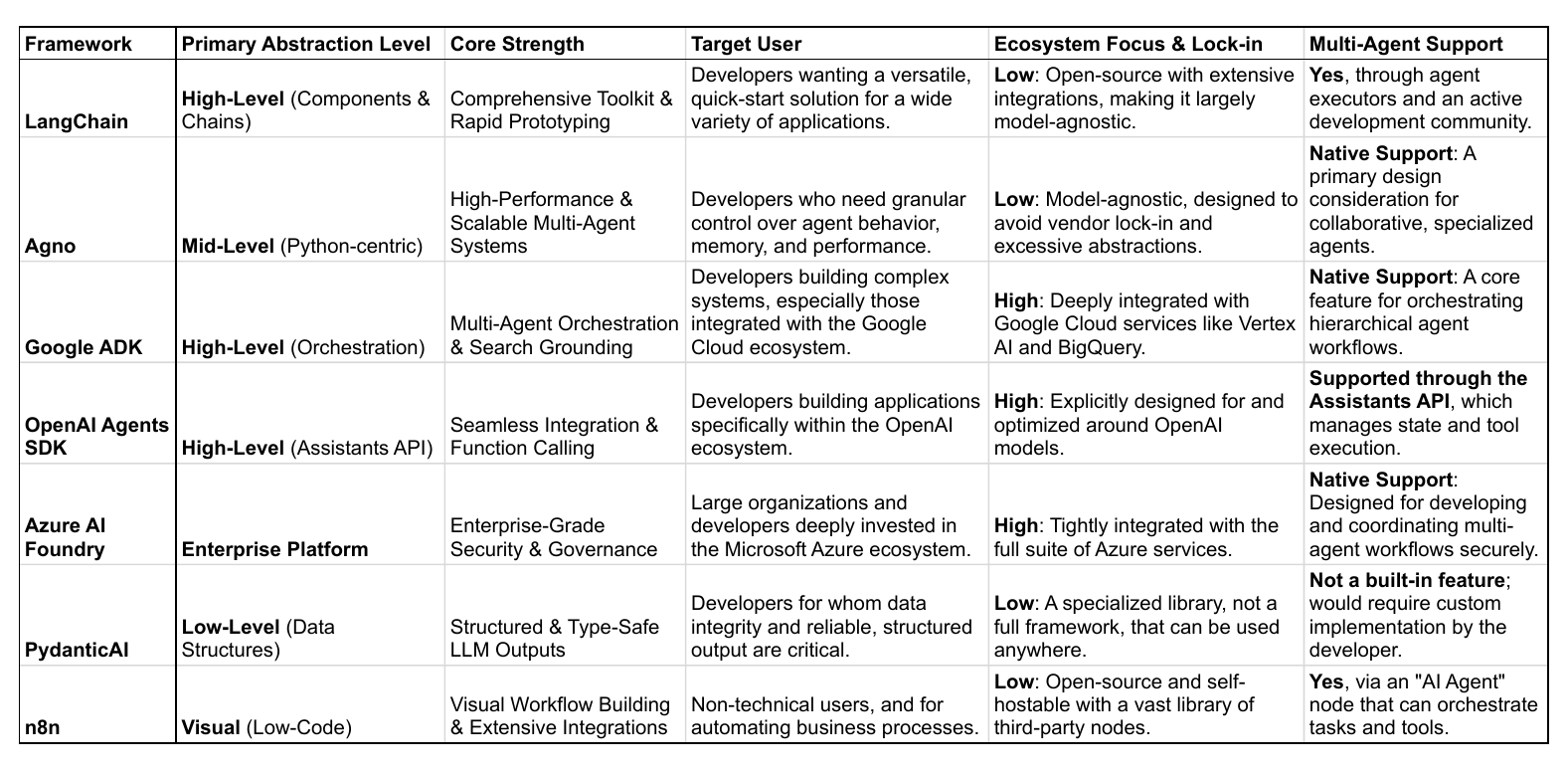
High-level comparison between seven agentic workflow frameworks.
The overview above is meant to help you find the best framework for your use case. If most of them seem to be rather similar than different, it is because they actually are!
Most of them have integrated tools, similar levels of abstraction, as well as nice features for monitoring, logging, and security. If multiple frameworks appear suitable, the best approach is often to prototype and evaluate them in practice. Real-world usage quickly reveals trade-offs that are not always visible on paper.
Share your experience with your favourite agentic workflow framework and let us know how it goes. If you think there are other frameworks worth mentioning in this blogpost, feel free to share them with us!
Read the part 1 of this blog-post: What Is an Agentic Workflow?