

Excecutive summary
Most Voice AI projects measure the wrong thing. "Deflection" counts calls that didn't reach a human, but it doesn't say whether the customer got what they came for. The metric that matters is contained resolution: the share of calls the AI handles end-to-end with the customer's intent fully resolved.
Push that number up on the right flows and you get a rare compounding effect: faster service for simple issues, more focused human time for complex ones, and a measurable lift in both customer and employee satisfaction. This post breaks down how the three call types behave, what to measure, and how the satisfaction mirror turns containment into a business outcome instead of a cost line.
The Contact Center Paradox
Customer service has a structural problem that no amount of staffing has ever solved cleanly.
Simple requests (a meter reading, a billing question, a tariff switch) clog the queue.
Complex requests (a disputed bill, a vulnerable customer, a multi-product issue) get pushed through that same queue. Agents end up rushing the conversations that need care, while customers wait too long for things that should take 30 seconds. Both sides end the call frustrated, which negatively impacts CSAT (Customer Satisfaction Score) and cost per contact.
Voice AI is often pitched as a way to eliminate this by removing calls from the queue. That framing is wrong, and it leads to the wrong metrics. The goal is not to have fewer calls, but rather to ensure the right call lands in the right place and is resolved.
Three Buckets, Not One
In an AI-enabled Voice setup, every inbound call ends up in one of three buckets. The mix is what determines the economics and the experience.
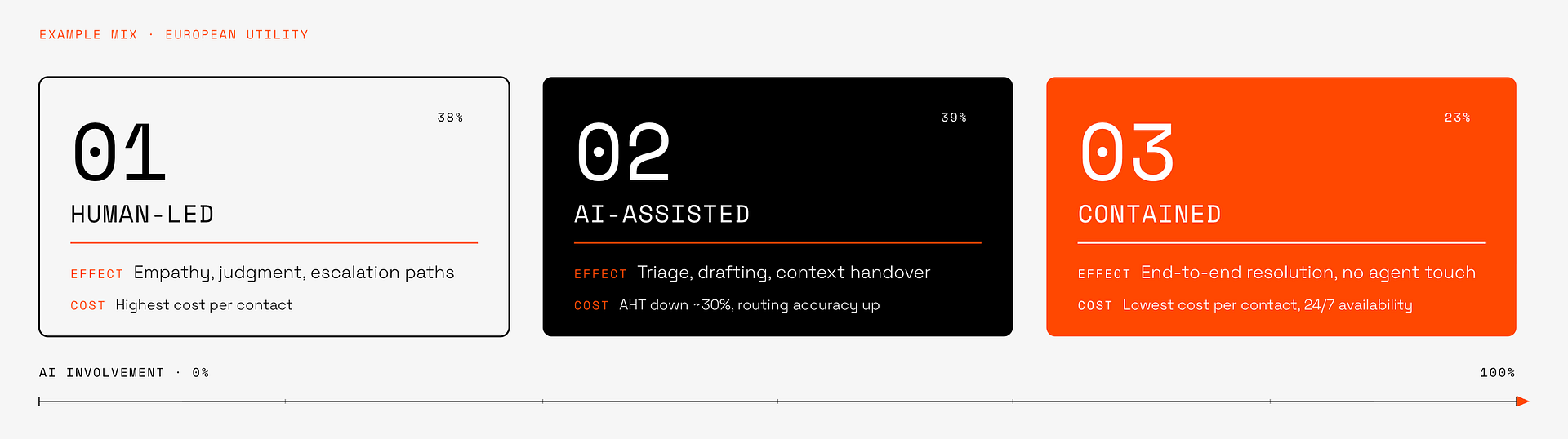
Human-led conversations
The call goes straight to a human agent. AI plays no role. No agent time is saved, and no AI cost is added. This is the right path for genuinely complex, sensitive, or relationship-defining conversations: vulnerable customers, complaints with legal exposure, contract negotiations. You want this bucket to exist, but you just don't want it to be 70% of your volume.
AI-assisted conversations
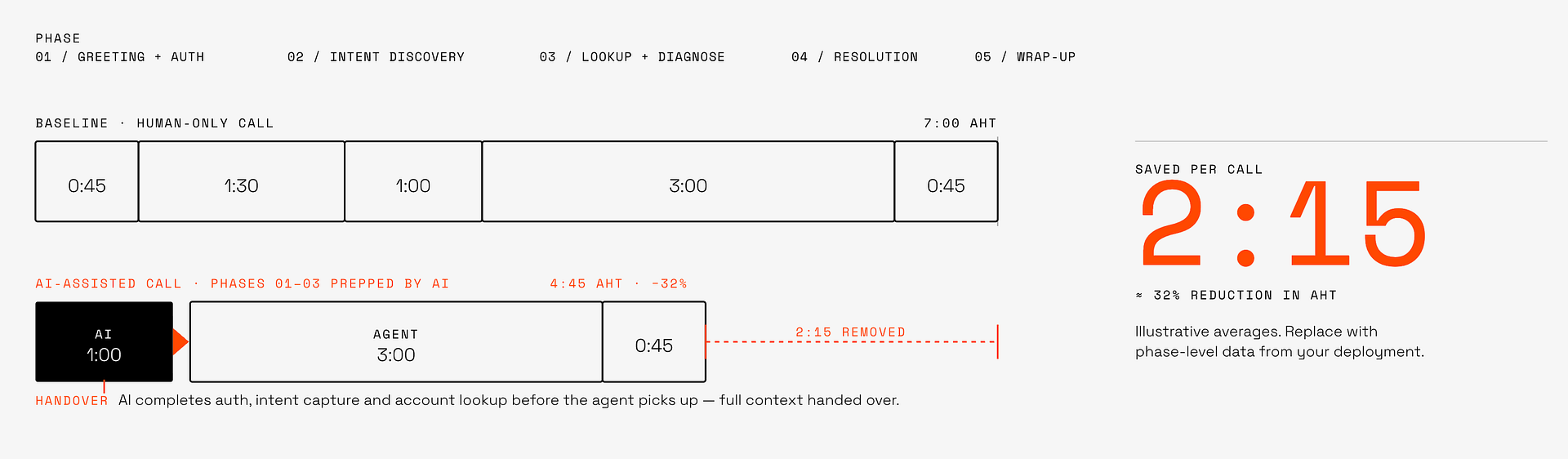
AI runs before or alongside the human. It handles intake, captures intent, authenticates the caller, attempts resolution on the parts it can, and routes to the right agent pool with full context attached. The agent doesn't start from scratch. On the calls that do reach a human, this typically cuts Average Handle Time (AHT) by around 30% - a band consistent with industry benchmarks reporting 20 to 35% AHT reduction on AI-assisted calls, because the first two minutes (intake and discovery) are already done.
Contained AI conversations
Here, AI handles the call end-to-end. The customer's request is resolved without a human ever picking up. No queue, no transfer, no follow-up ticket. Full agent time saved on that call, and resolution at the moment of contact rather than 14 minutes into a hold.
How To Distribute These Buckets?
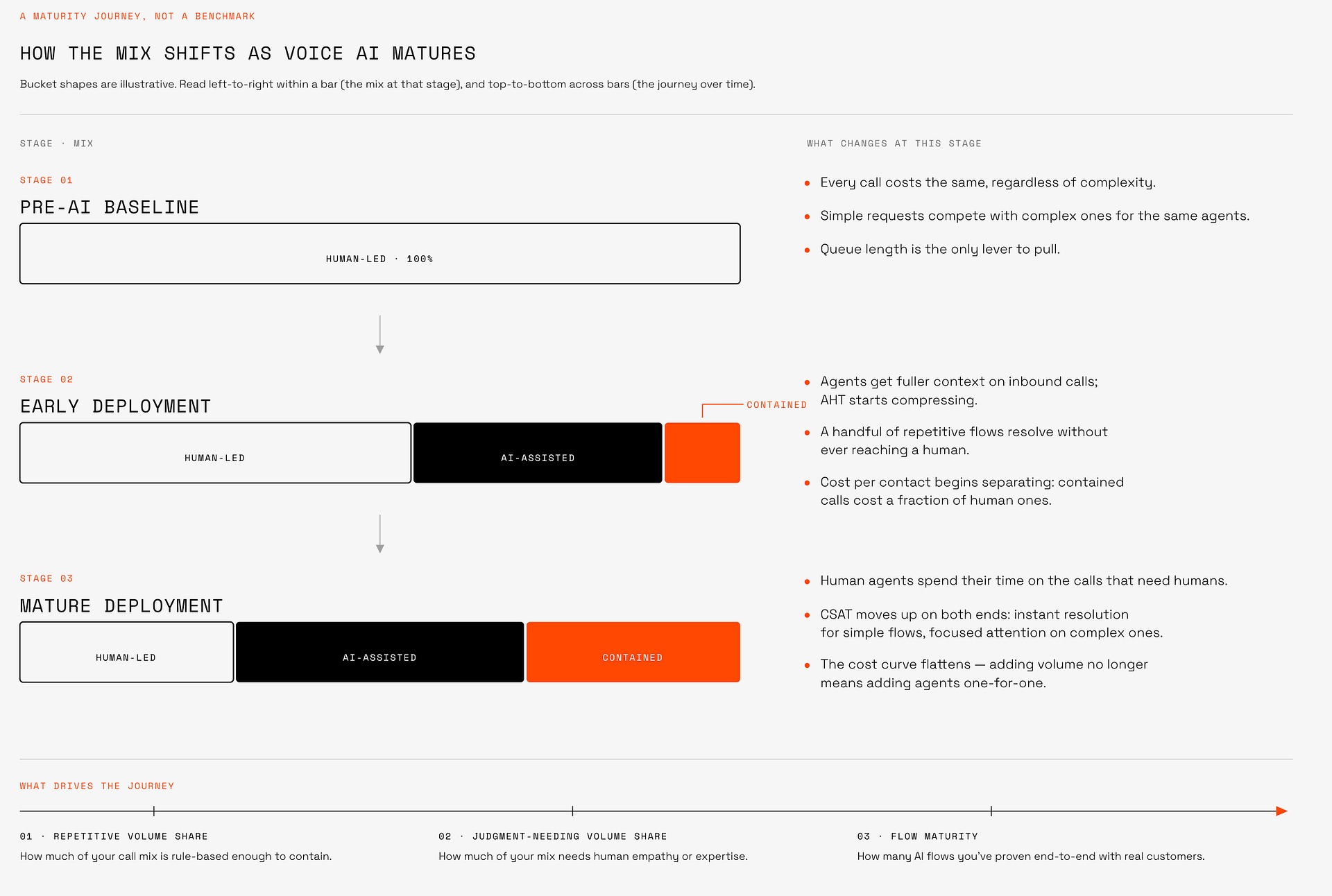
The mix matters more than any single number. A healthy distribution depends on three things. First, the share of your call volume that is genuinely repetitive and rule-based, where containment is realistic. Second, the share that needs judgment or empathy, where humans add the most value. Third, how mature your AI flows are: early deployments lean heavily on AI-assisted than on contained until the contained flows prove themselves.
The mix is the output of those choices, not a target you set up front. Get those choices right and the economic effect follows: cost per contact drops on the contained and assisted flows, while CSAT rises on the human-led ones because the agents working them are no longer also fielding password resets between every complex case.
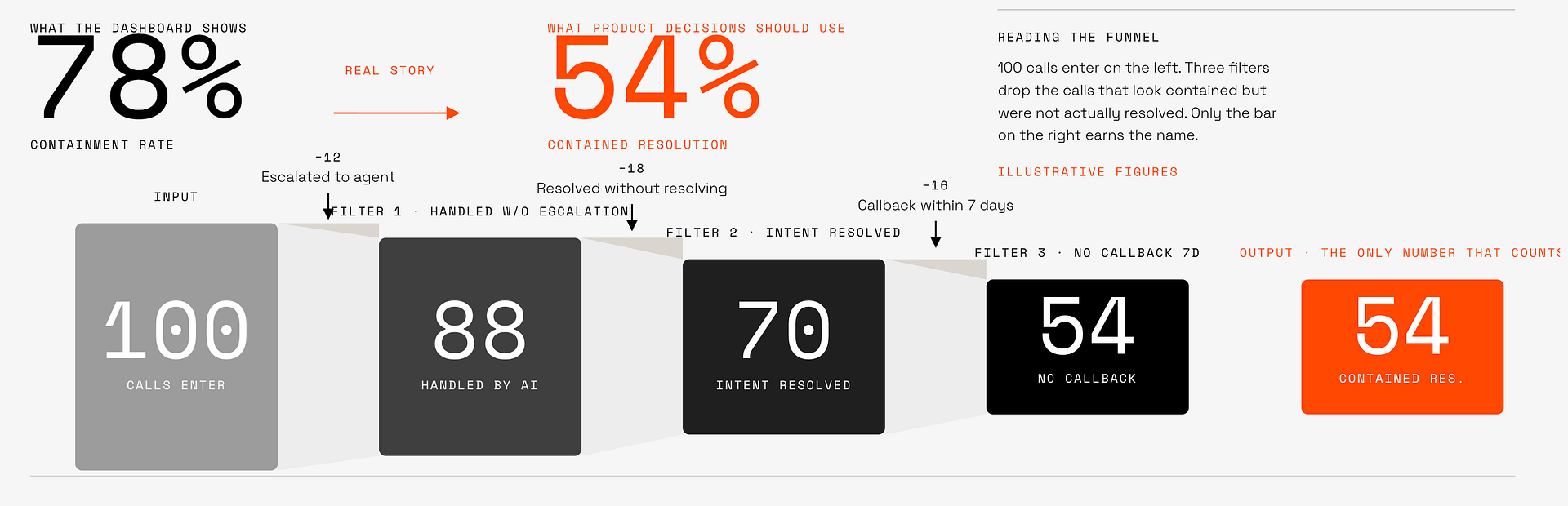
Containment is a resolution metric, not a deflection metric
Here is where most projects go wrong. Teams optimize for containment as if the goal were to stop calls from reaching a human. That definition is dangerous, because it rewards the wrong behavior. An AI that hangs up on a confused customer "contains" the call. So does an AI that loops them through a dead-end menu until they give up.
The version of containment that's worth chasing is narrower: the call was fully handled inside the AI flow, the customer's intent was resolved, and they did not need to call back. These are three conditions, not one. Strip any of them out and you're measuring noise.
This reframing changes what you build. You stop trying to contain everything, and you start picking the flows where resolution is genuinely achievable inside an AI conversation: account lookups, meter submissions, payment plans, appointment scheduling, status checks, tariff information. For each flow, you ask whether the AI can finish the job, not whether it can answer the first question.
Two metrics keep this honest:
- Containment rate: share of calls handled fully by AI without escalation.
- First-call resolution (FCR) within containment: of the contained calls, how many did not result in a callback or repeat contact within a defined window (commonly seven days).
The first number is easy to game. The second one is not. Track both, and the gap between them tells you whether containment is real or theatrical.
What "AI-assisted" Actually Buys You
The middle bucket is the most underrated of the three. It rarely shows up in vendor pitches, because "we made human calls slightly better" is harder to put on a slide than "we removed 25% of your volume." But this is where a large share of the economic value sits.
A few things happen when AI runs the intake and handoff:
- First-time resolution goes up. The agent receives the call with intent already classified, account already authenticated, and any obvious diagnostics already run. They start in the middle of the problem, not at the start.
- Routing gets sharper. Intent is known before the call lands, so the customer reaches the right agent pool the first time. Cross-agent transfers, a well-documented CSAT killer in contact-centre research, drop accordingly.
- AHT compresses. Around 30% on these calls, in line with what ML6 deployments and published industry benchmarks consistently report. That number is not magic, it comes from the simple fact that the agent does not redo work the AI already did.
- Agents feel the difference. They get fewer "start from zero" calls and more "here is the situation, here is what's been tried" calls. That changes the texture of the job.
The third bucket gets the headlines. The middle bucket pays the bills.
Why This Compounds
There's a well-documented effect in service research called the satisfaction mirror, formalised in 1994 by Heskett, Sasser, and Schlesinger within the broader service-profit chain. The short version: employee satisfaction and customer satisfaction are not independent variables. They move together, and each one reinforces the other.
The mechanism is straightforward. Employees who feel supported (by their tools, their management, their workload) deliver better service. Customers respond to that, and their appreciation flows back to the employees as positive interactions instead of complaints. Morale rises, service quality rises with it, and the loop tightens. Disengaged employees produce the inverse: rushed calls, defensive scripts, unhappy customers, more complaints, more disengagement. The loop runs in both directions.
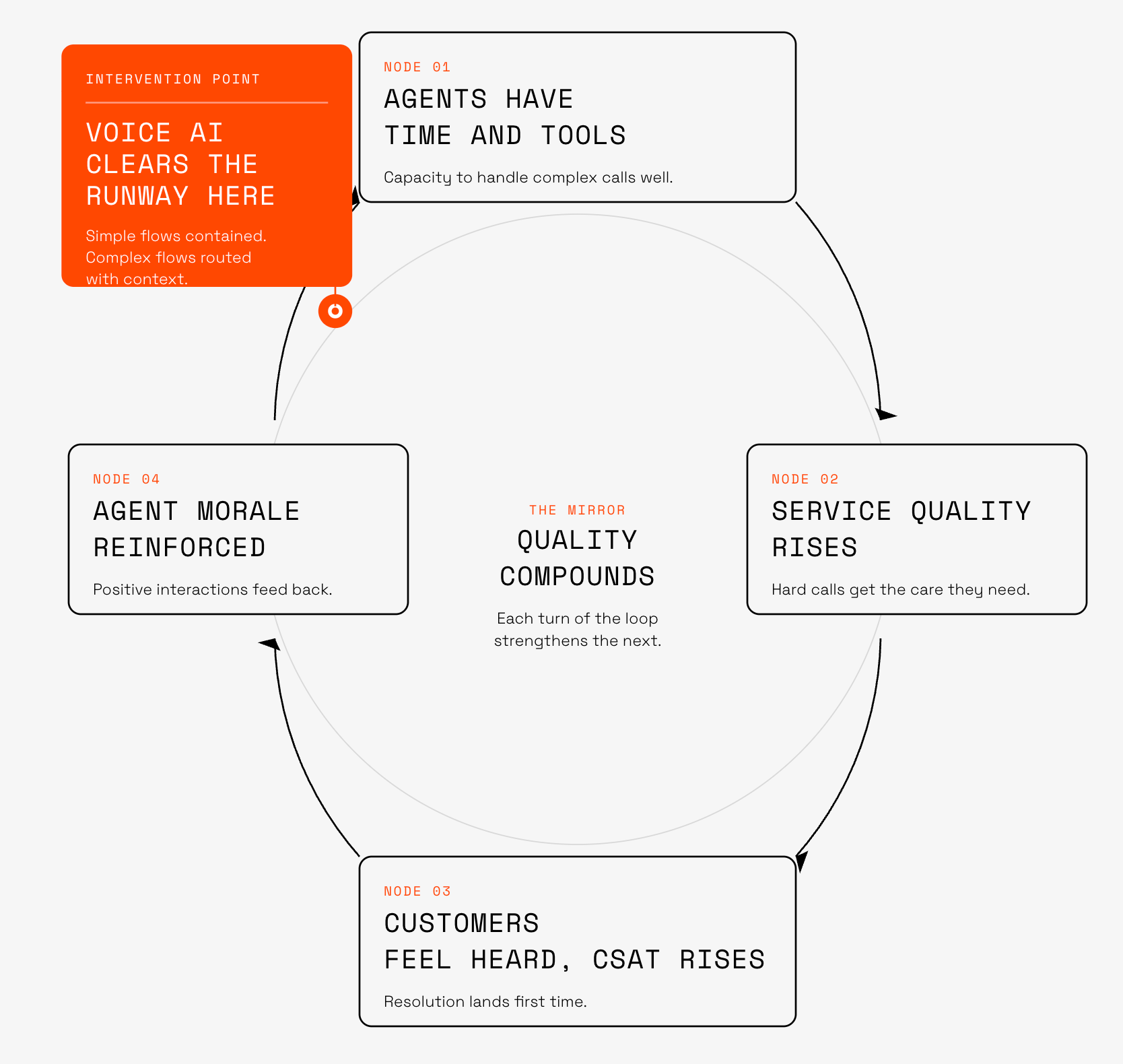
Voice AI, deployed well, intervenes at the most leveraged point in that loop: the agent's daily call mix.
When containment is high on the right flows, human agents stop spending their day on meter readings and password resets. They spend it on the calls that actually need a human: the complaint that requires judgment, the vulnerable customer who needs time, the loyalty save where empathy matters more than throughput. Those calls are also the ones where agent skill compounds, where experience pays off, and where the work feels meaningful.
The economic effect is symmetrical:
- Customers with simple needs get resolution in seconds, at any hour, with no queue.
- Customers with complex needs reach a less harried agent who has more time, better context, and is not racing the clock to clear the backlog.
- Agents handle a higher share of work that actually uses their skills.
- The business sees lower cost per contact on the simple end and higher CSAT on the complex end.
This is the part that matters: CSAT does not improve because the AI is impressive. It improves because the human conversations get better. The AI's job is to clear the runway.
How to Measure Success
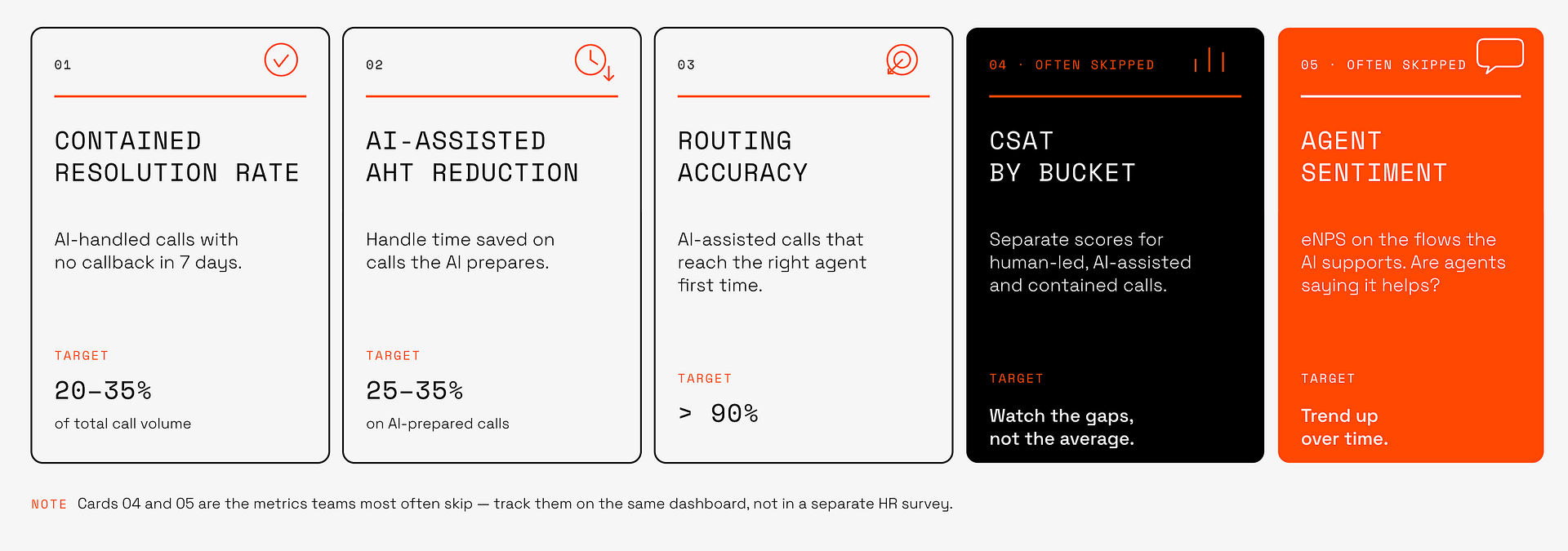
A useful Voice AI dashboard has more than a containment number on it. We typically track five:
- Contained resolution rate. Calls fully handled by AI with no callback in seven days. The headline number.
- AI-assisted AHT reduction. Average handle time on AI-assisted calls vs. baseline human-only calls. Target: 25 to 35%.
- Routing accuracy. Share of AI-assisted calls that reach the correct agent pool on the first transfer. Target: above 90%.
- Post-contact CSAT, split by bucket. Contained, AI-assisted, and human-led calls each get their own CSAT score. The interesting signal is the gap, not the average.
- Agent NPS or eNPS (Employee Net Promoter Score) on the supported flows. Ask the agents directly whether the AI is making their day better or worse. If this number drops, something is off, regardless of what the cost dashboard says.
The last two are the ones most teams skip. They are also the ones that tell you whether the satisfaction mirror is actually turning in the right direction.
What Good Looks Like
A well-tuned Voice AI deployment in customer service has a recognizable shape. The contained bucket is meaningful but not maximized at all costs, typically 20 to 35% depending on industry and call mix. The AI-assisted bucket is large, often 35 to 50%, because intake-plus-routing is genuinely useful on most calls. The human-led bucket stays substantial, 20 to 35%, because the calls that route straight to humans are the ones where humans add the most value.
CSAT moves in two directions at once: up on simple flows (because resolution is instant) and up on complex flows (because the human agent has more time and better context). Cost per contact drops on the simple end. Agent retention improves, because the daily call mix gets more interesting and less repetitive.
The companies that get this right have stopped asking "how do we deflect more calls?" and started asking "where can resolution genuinely happen without a human, and where is the human the whole point?" That question, asked flow by flow, is what separates a Voice AI project that pays back from one that just shifts the problem.
If you are scoping a Voice AI deployment, our team can walk you through the bucket distribution against your call profile. Get in touch with the ML6 Voice AI team to start the conversation.
Key takeaways
- Containment without resolution is a vanity metric. Track contained resolution (no callback within seven days), not raw containment.
- The AI-assisted bucket, where AI runs intake and routing for human-handled calls, is where most of the economic value sits. Roughly 30% AHT reduction is realistic.
- The mix of human-led, AI-assisted, and contained calls is the real design choice. There is no universal target ratio, only a defensible one for your call profile.
- The satisfaction mirror means CSAT and agent experience move together. Voice AI's biggest lever on CSAT is freeing up human agents to do the human work properly.
- Measure five things, not one: contained resolution, AHT reduction on assisted calls, routing accuracy, CSAT by bucket, and agent sentiment.