

Executive Summary
In high velocity B2B2C sectors such as Fast Moving Consumer Goods, the traditional view of Customer Service and Order-to-Cash as separate or merely ‘intersecting’ processes is a legacy of the past that companies can no longer afford. They are, in fact, a single, unified cycle. In an industry where speed is money, any delay in information flow within this cycle acts as a ‘friction tax’ on margins and customer satisfaction. To survive in a world defined by volatility and hyper-fast supply chains, organizations must transition from reactive customer service to a proactive Agentic Orchestration model.
By deploying a multi-agent AI system as an intelligent, proactive layer above existing ERP and CRM infrastructure, companies can unify logistics, finance, and sales related processes into a self-correcting organism. This shift redefines the human element, moving customer service agents from reactive complaint handlers to strategic orchestrators of service delivery. The result is a measurable transformation: reducing administrative costs and increasing customer satisfaction by taking action before friction ever reaches the customer.
Agentic AI for Order-to-Cash: Synchronizing , Supply Chain, Finance and Customer Service
In the high-stakes FMCG industry, speed is the ultimate survival mechanism. Increasing margin pressure and fragmenting brand loyalty mean that any delay—whether it’s a logistics bottleneck, a stockout, or a slow response to a customer—immediately drives retailers and consumers to choose a competitor’s product. Maintaining a high velocity in both supply chain management and customer service is critical to protect market share and ensure your brand remains the convenient choice in a landscape of endless, near-identical alternatives.
The Internal Information Gap: The Cost of ‘Late Truth’
A fundamental challenge for manufacturers and distributors is that critical issues—line breakdowns, inventory shortages, transport delays, exceeded credit limits, master data issues —are often known or at least discoverable somewhere within the company, but fail to reach customer facing Customer Service teams fast enough.
The Communication Lag
Because data is frequently trapped in functional silos (Supply Chain, Finance, Sales…) or with external logistics and supply chain partners, Customer Service often remains unaware of a problem until a customer calls to complain about a late delivery, a missing pallet, an incorrect invoice or a wrongly calculated rebate payment. In many organizations, Customer Service agents spend significant amounts of their time just chasing the information to investigate and solve these complaints. As a result, customers feel that service delivery is slow and inconsistent and that manufacturers ‘left hand does not know what the right hand is doing’
The Tax of Inaction
This reactive stance gives rise to a surge in avoidable complaints and the associated workload required to investigate, process and address them. This in turn often leads to costly corrective measures such as emergency deliveries, where the relative costs can be significantly higher than normal.
Beyond Static Record-Keeping
While ERP and CRM systems are vital for data storage, they are rarely optimized to bridge the real-time gap between operations, logistics, order processing, invoicing, credit, collections, rebates and discounts, master data and customer-facing teams. Legacy planning processes act like driving a car while looking only at the rearview mirror. Organizations need a synchronized system where real-time data flows directly into automated adjustments.
Why this matters now
The business case for synchronizing Customer Service and Order-to-Cash is getting stronger. McKinsey estimates generative AI can increase productivity in customer care by 30–45%. Salesforce reports that 82% of service professionals say customer expectations are higher than they used to be, while 88% of customers say good service makes them more likely to purchase again. In finance, PwC found that 36% of finance departments are already using AI in accounts receivable and accounts payable, with another 24% planning adoption within 12 months.
The Strategy: Building an Intelligent Agentic Overlay
🔎 What is Order-to-Cash? Expand for definition.
The order-to-cash (O2C) cycle covers the entire business process from receiving a customer order to collecting payment. It typically includes order management, delivery execution, invoicing, credit, collections, disputes & deductions and accounts receivable as well as the customer complaints and enquiries management spanning this cycle. O2C typically also deals with customer master data, bonuses and rebates and sales back office activities.
True operational agility does not require a costly rip and replace of your core back-end systems. Instead, the most effective path is building an Agentic AI layer on top of your existing stack to act as a proactive, connective tissue that knits the order to cash cycle together across process steps and departments. This synchronised O2C engine replaces static snapshots with a continuous cycle of intelligence.
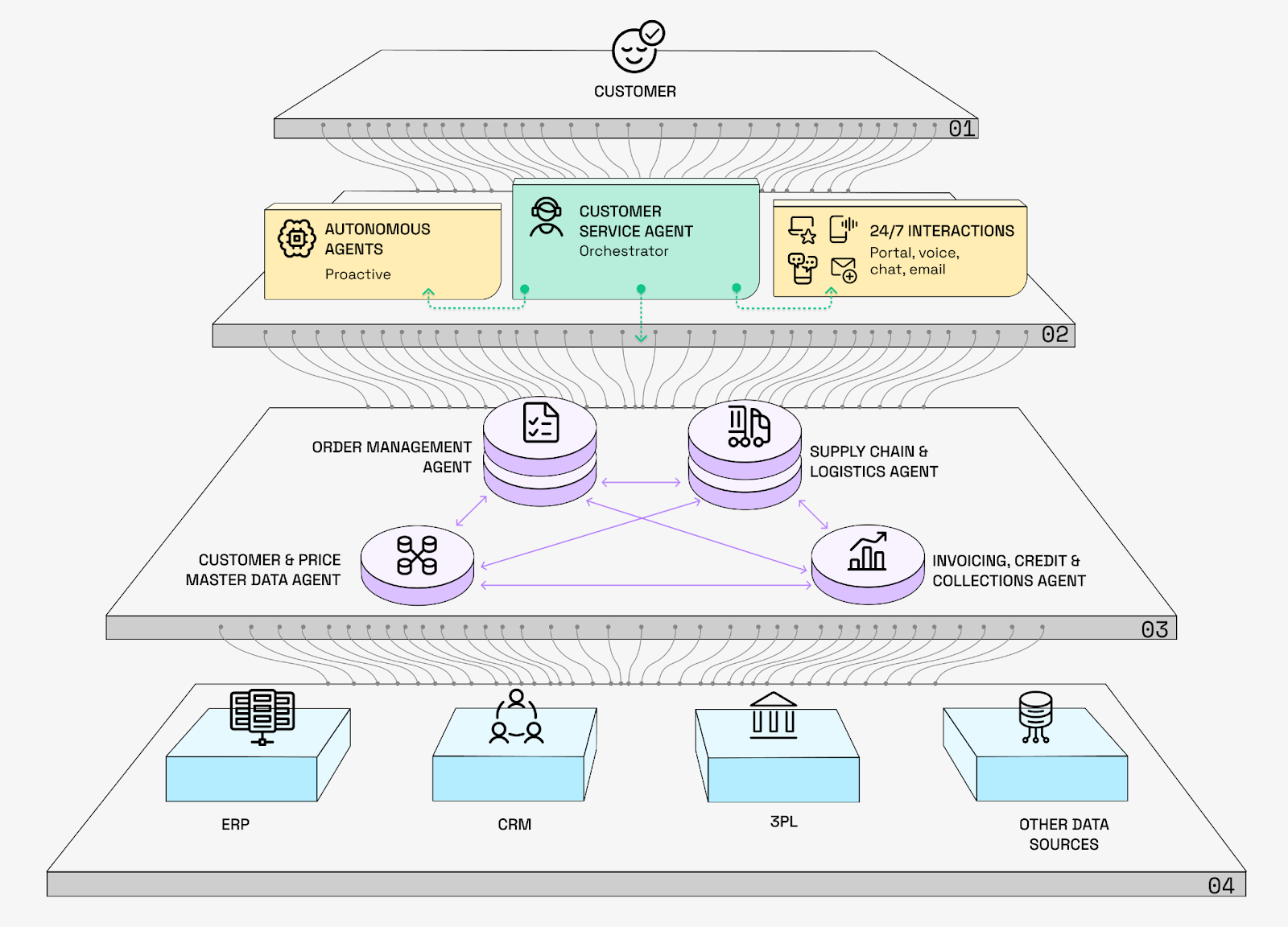
For example:
- Order management agents can crawl internal ERPs and supply chain systems to provide instant visibility into order status, stock levels and transport capacity
- Logistics agents track delivery execution in real-time across the distribution network. By ingesting custom signals like traffic and port congestion or weather, it can predict delays and suggest specific solutions, such as rerouting deliveries or reallocating inventory
- Finance agents can carry out credit checks, analyze customer profiles and payment behavior to suggest optimal collections strategies and calculate bonus and rebate payments in real time
Meaningful 24/7 Engagement: Beyond the "Dumb Portal"
Modern B2B relationships require more than static customer portals, they need meaningful, real-time interactions that understand the customers context
Intelligent Voice and Chat
Specialized agents can handle routine inquiries—think taking orders, checking delivery status, requesting duplicate invoices, or reporting missing items—through natural language interfaces. This provides a single point of contact for service along the O2C cycle with deep segment knowledge.
Serving the Non-Standard Clock
This enables 24/7 service for partners who do not work standard office hours. Think on-trade channel outlets in the beverage sector (like a bar or restaurant) who can place an order or resolve an invoice discrepancy at midnight through a voice assistant without waiting for the morning shift
Automated Mitigation
By the time a wholesaler or distributor reaches out, the AI agent already knows the internal status of the order. It doesn't just warn of a delay, it offers an immediate, pre-approved solution like an alternative SKU or a re-scheduled delivery window
The Human Element: From Data Hunter to Strategist
AI is not a "black box" designed to replace human judgment; it is a co-pilot intended to augment it.
Strategic Orchestration
The goal is to move humans toward strategic service orchestration while machines handle the heavy lifting. The human's role shifts from chasing data to orchestrating problem resolution and managing customers. Instead of spending time manually reconciling information, Customer Service staff can focus on organizing solutions before customers even know a disruption has occurred.
Empowered Service
Armed with a comprehensive, integrated view of the entire Customer Service and O2C cycle, staff can resolve issues in minutes that used to take hours or even days of departmental back-and-forth. This increases first-contact resolution rates and reduces the total volume of activity through root cause identification.
Field Sales Freedom
Too often, sales teams spend excessive time on service and O2C issues. By letting AI agents handle the routine heavy lifting, field sales teams are finally freed to focus on their core expertise: selling, building partner relationships, and driving customer satisfaction.
A case in point
Danone for example implemented an autonomous agent that analyzes all customer orders regardless of format and cross-references prices against internal systems such as ERP and promotional tools. It also proactively detects potential discrepancies so that any issues can be resolved before invoicing takes place. The autonomous agent goes beyond simple error detection, it provides actionable recommendations, suggests tailor pricing adjustments, and can even generate professional email drafts to help employees quickly resolve pricing issues with clients.
By resolving pricing discrepancies before invoices are issued, the system also helps reduce disputes and payment delays, improving cash flow predictability across the Order-to-Cash cycle.
Source: Microsoft, Danone accelerates order processing with AI agents.
What This Means for Consumer businesses
Synchronizing Customer Service and Order-to-Cash requires more than automation of individual tasks. It requires the ability to connect operational data and processes that span multiple functional areas with customer interactions across complex enterprise systems.
At ML6, we design and deploy AI systems that orchestrate processes across supply chain, finance and customer service within the Order-to-Cash lifecycle.
Conclusion
The most damaging failures in Order to Cash are not caused by bad decisions, but by decisions made too late. They stem from a lack of a connected end-to-end process compounded by unclear ownership and poor governance.
Organizations looking to modernize their Order-to-Cash operations with AI should start by identifying where information friction occurs across customer service, logistics and finance workflows—and where real-time visibility could prevent issues before they reach the customer.
By deploying an agentic orchestration layer that forces internal information to flow faster than the problems it creates, companies move from reactive firefighting to predictive service orchestration. You win in this volatile Order to Cash landscape not by reacting faster, but by seeing the wave before it hits. The era of surprise is over. The era of Synchronized Customer Service & Order-to-Cash has arrived.