
Executive summary
Agentic commerce readiness means that AI agents can find, understand, and recommend your products, and that your own channel offers an experience customers keep coming back for. It rests on four layers: AI-ready product data, advanced CX (an advanced customer experience on your own site and app), a connected ecosystem (a secure connection to AI assistants such as ChatGPT or Gemini), and the Connected Consumer Context, the shared layer that connects the other three. According to BCG (October 2026), CPG companies see 3 to 10% revenue growth in pilots with their own agents and ecosystem integration, against 1 to 5% in pilots that focus only on visibility in AI answers. ML6 takes retailers and CPG organizations from use case to a live MVP within three months.
The race is about margin and customer retention
Anyone who walked around e-commerce and retail conferences in recent weeks heard the same promise everywhere: agentic commerce will permanently change the way consumers buy. Agentic commerce is shopping in which an AI agent searches for, compares, and buys products on behalf of the consumer, within the limits the consumer sets.
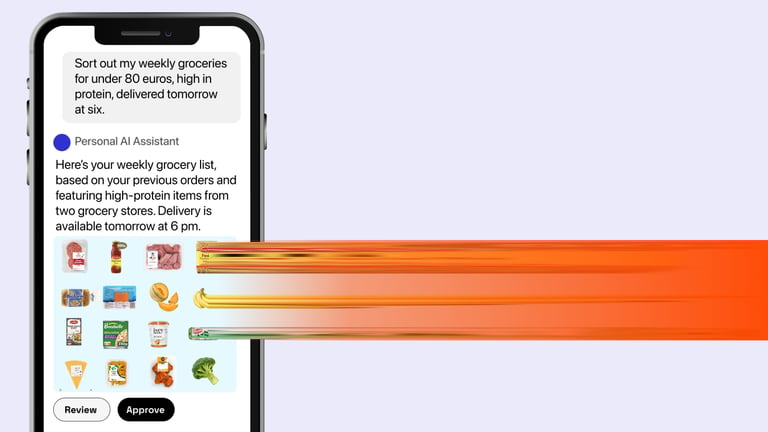
Take a consumer who tells their AI assistant: “Sort out my weekly groceries for under 80 euros, high in protein, delivered tomorrow at six.” That agent looks at price, stock, and product data. Banners, shelf layout, and impulse purchases no longer play a role.
This creates two kinds of agents. The store or brand agent sells on behalf of the company. The consumer agent serves only the consumer. Whichever of the two holds the conversation determines who keeps the margin and the customer data. For decision-makers in retail and CPG (consumer packaged goods), that means:
- Retailers earn little on the product itself and a lot on retail media: brands pay for visibility at the moment of purchase. If the consumer starts their purchase journey in ChatGPT or Gemini, that visibility moves with them, and so does the brand's advertising budget.
- CPG brands pay retailers today for a good spot on the shelf and in the webshop. If an agent chooses the product, that spot no longer counts. Google calls this the invisible shelf: a leading brand is not rejected by a human, but silently skipped by a machine.
Where do retailers and CPG brands start today?
Most retailers we speak to start with their search bar. It becomes a conversational assistant that compares products, suggests recipes, and applies filters. That is a logical first step, because it keeps the customer on the retailer's own channel. It just isn't agentic commerce . The assistant searches and advises, but it does not act on behalf of the customer and cannot be reached by the consumer's agent. Anyone who stops there has a better search function and the same risk.
A CPG brand knows more about its products than any retailer. In categories where the consumer needs explanation, such as skincare, baby food, or sports nutrition, an agent on the brand's own site can put that knowledge to work. Which product suits me, how do I use it, and how does it differ from the alternative? The brand gains something it never got through the shelf: a direct conversation with the consumer and its own customer data. The purchase itself can simply stay with the retailer.
What does agentic commerce readiness require? Four layers.
Many organizations think that being ready for agentic commerce means putting a chatbot on the website. A conversational interface is the tip of the iceberg.
BCG presented their flywheel for Winning Agentic Commerce. We’ve translated that into what you need to build to be ready.
- AI-ready product data: agents can read your products.
- Advanced CX on your own channel: your own site and app advise and sell better than an external platform.
- Connected ecosystem: external agents can reach you securely, within your rules.
- Connected Consumer Context: every agent works from the same customer knowledge, the same systems, and the same rules.
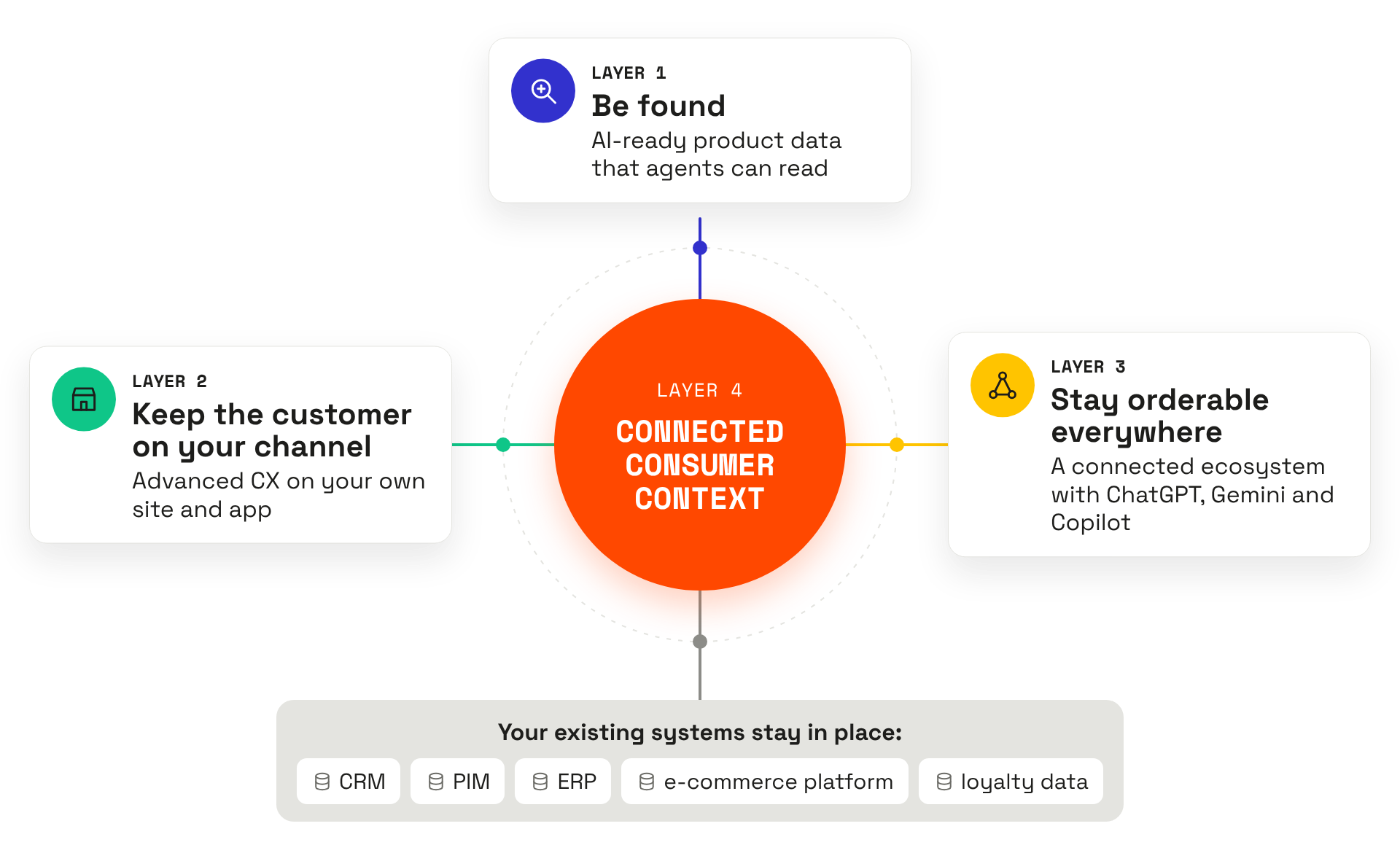
The four layers of agentic commerce readiness: AI-ready product data, advanced CX, and connected ecosystem, connected by the Connected Consumer Context
Layer 1: AI-ready product data and GEO
An agent doesn’t buy based on attractive packaging, but on structured, rich product data: ingredients, allergens, sustainability scores, usage scenarios, and real-time stock. That is the shift from SEO to GEO (generative engine optimization): being findable in AI answers.
This is the entry ticket, not the differentiator. For GS1 BelgiLux, ML6 cut product label processing from 24 to 48 hours down to real time. For another retailer, an agent generates around 498,000 lifestyle images a year. Being visible is the first step. The revenue sits in the layers above it.
Layer 2: advanced CX on your own channel
Your own channel is where you keep the customer data, the margin, and the relationship. If 96% of AI shoppers use AI for discovery (BCG, October 2026), your own site or app has to do that discovery better than ChatGPT. That only works with an experience that goes beyond searching and filtering. Customers know what they need, not which filters to set.
Retailers that built their own shopping assistant are now reporting the results to investors:
|
Retailer |
Own assistant |
Reported result |
|
Lowe's |
Mylow |
Online customers who use Mylow convert at 3x the rate of those who don't. It handles more than 1 million customer questions a month. |
|
Walmart |
Sparky |
The US uses up 129% in a year. Baskets linked to Sparky are 40% larger. |
|
Target |
Ask Target (beta, launched October 2026) |
Early users move to purchase at about twice the rate. |
Sources: Lowe's, Q1 2026 earnings call transcript (20 May 2026); Walmart, Q3 FY2027 earnings call (19 November 2026), as reported by PYMNTS; Target, Q3 2026 earnings call (18 November 2026), as reported by Retail Dive. Figures as reported by each company; not independently verified. Product names are trademarks of their owners. ML6 is not affiliated with these retailers.
In practice, we see three forms that generate revenue:
- From intent to order. Automation shortens and simplifies the customer journey. At Smartphoto, that meant designing a photo book from 600 or more unsorted photos. Instant Creator turns them into an orderable book in under a minute. The customer makes one decision instead of more than 600. The feature went live within ten weeks and sold around 10,000 photo books.
- Advice on fit, not just on price. For a global insurer, we built a comparison engine on its own data and are now turning it into a guide. It explains how the product works, asks what matters to this customer, and ranks the options by fit. It says so when its recommendation is not the cheapest. The purchase stays with the brand.
- A guide through a complex journey. With Scout24, we rebuilt HeyImmo, the assistant of the German property platform ImmoScout24, which has around 19 million users a month. Satisfaction rose from 68% to 75%, and the first answer arrives within five seconds instead of eight.
For retail and CPG, the same principle applies in a different context. A customer says: "I'm cooking for six vegetarians on Saturday." A good agent understands that context and fills the basket across categories, from recipe to wine and kitchenware. For retailers, that is the engine behind bigger baskets. For CPG brands, an advisory agent of their own, such as a virtual skin coach or a meal planner with a where-to-buy link, is the way to build first-party data (their own customer data) that they never get through the shelf.
The experience does not end with the answer. The same agent resolves a service question and then offers the right next step, acts before the customer drops off, and feeds complaints and return reasons back into the assortment.
For one of the world's largest retailers, we built a new shopping journey on recipe data, with a language model as the interface.
Layer 3: connected ecosystem
More and more people start their purchase with an AI assistant such as ChatGPT, Gemini, or Copilot. That channel isn't yours, but you still want to be findable and orderable there.
In the US, we are already seeing two opposing reactions to this shift. On one side is the defensive reflex: Amazon blocked Meta Muse from accessing its site in September 2026, and many retailers still block AI crawlers by default. On the other side is agent syndication: after OpenAI retired its native Instant Checkout in March 2026 due to low conversion, Walmart took a smarter route by bringing its own agent, Sparky, directly inside ChatGPT. ChatGPT hosts the conversation, while Walmart keeps control over pricing, stock, Walmart+ loyalty, and the final checkout.
Being connected to that ecosystem, rather than mindlessly blocking it or handing over your customer relationship, means an AI agent can interact with you on your terms. That requires three things:
- An offer an agent can use. An agent does not read web pages the way a human does. It needs your catalog, prices, and stock as structured data, and must be able to hand over to your checkout or answer a service question.
- Open standards. Agents connect through agreed standards, such as the Model Context Protocol (MCP). For commerce, these are joined by Google's Universal Commerce Protocol (UCP)—launched in January 2026 with Shopify, Walmart, and Target—and OpenAI and Stripe's Agentic Commerce Protocol (ACP) Building on open standards means you do not have to rebuild for every new AI platform.
- Your own rules. What offers may an agent make, within what margin, and in what tone? When do you route the user to your own checkout, and when does a human take over? You decide that, not the platform.
What does a connected ecosystem deliver?
For a CPG brand: an external agent can find your product and refer the consumer to the exact retailer where it is in stock. That is the direct answer to the invisible shelf.
For a retailer: you capture high-intent AI discovery traffic—which already converts significantly better than traditional search—without surrendering your checkout, loyalty data, or margins to a third party. Europe currently trails the US by roughly 9 to 12 months on these agent channels, giving European leaders a clear window to put their protocols and rules in place before the wave hits.
Layer 4: The Connected Consumer Context
One layer lets every agent know your customer, act in your systems, and stay within your rules.
Agents are arriving from every direction. Your CRM vendor ships one, your commerce platform another, your service desk a third. Each works well for generic tasks inside its own tool. None of them knows what the others know. The result is the old silo problem in a new form: a service agent that cannot see the order, a shopping agent that recommends what is out of stock, a marketing agent that does not sound like your brand.
The Connected Consumer Context sits between your existing systems and your agents. Every agent uses the same layer, whether it runs in your app or serves an external agent.
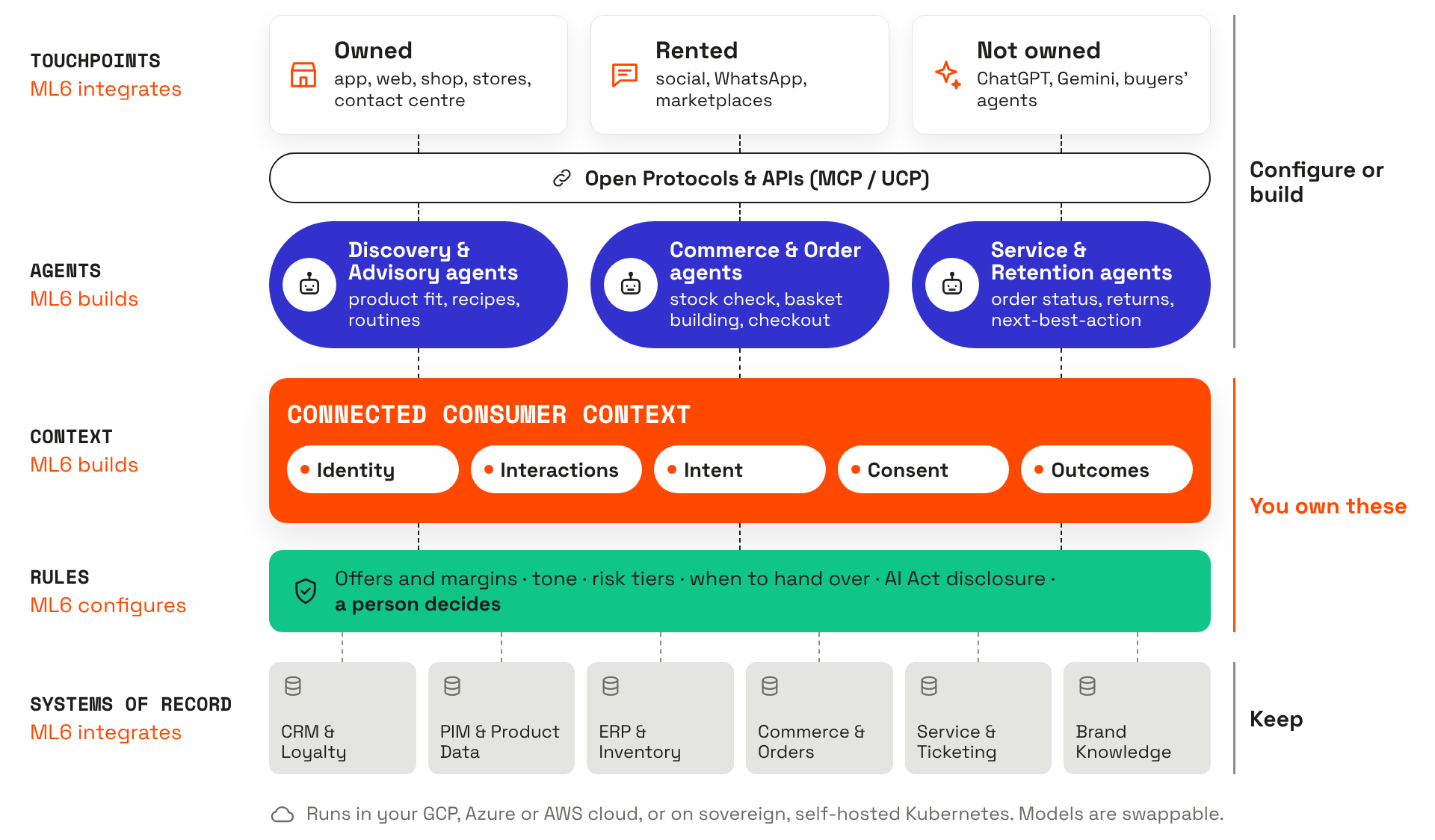
The Connected Consumer Context as a shared layer between AI agents and existing systems such as CRM, PIM, and ERP
It gives every agent three things:
- Know. One view of the consumer (identity, interactions, intent, consent, and outcomes), plus your product knowledge and brand voice.
- Act. Secure access to your systems of record, such as CRM, PIM, ERP, stock, and orders. An agent can check availability, change an order, or start a return, instead of only answering questions. Your stack turns from a system of record into a system of action.
- Stay in control. One place for your rules: which offers, within which margin, in which tone, and when a human takes over. Every action leaves a trail, which supports transparency under the AI Act.
It is listed fourth, but it is built first: the first use case creates it, and every agent after that reuses it.
It is not a new system that replaces your customer system (CRM), product information system (PIM), ERP (enterprise resource planning), or e-commerce platform. Those stay in place. The context is built on top of them and unlocks them for agents. It is also not another platform to buy. Your cloud provider already delivers most of the building blocks. What is missing is the connection to your business.
Why this is the core of agentic readiness:
- Whoever owns the context keeps the relationship. Even when the customer comes in through an external platform, and even when you rent the agents rather than build them. Whoever owns the customer data can also prove that a recommendation led to a purchase, and that proof is what makes retail media valuable.
- Every subsequent agent gets cheaper. The first use case pays for the context. The second and third reuse it.
- The customer sees one company. Marketing, sales, and service act on the same information, instead of each on its own fragment.
- You can change vendors without starting over. Agents and SaaS tools plug into the layer. Replacing one does not mean rebuilding what you know about your customer.
Exposing an API to an agent takes minutes. Letting agents act safely for your customers is the real work: identity, permissions, guardrails, and a trace of every action. Solve that once, and every next agent reuses it.
Today, AWS, Google Cloud, and Microsoft Azure supply the infrastructure out of the box, so we don’t rebuild what you already pay for. Our work starts where the platforms stop: defining what each agent should know and may do, connecting it to your systems, and bringing the agents you already have under one set of rules. We start from one business case and build only as much of the layer as that case needs. Where data sovereignty requires it, we build and host components ourselves.
Where ML6 adds value
A vision document does not generate revenue, and neither does an isolated chatbot hooked up to a generic API. To truly win in agentic commerce, you need a partner that masters both the customer-facing experience and the data foundation underneath it.
At ML6, we bring deep, hands-on production experience across all four layers of agentic commerce readiness:
- Proven across every layer in production: From building an educational brand agent that advises on fit at a global insurer, to a recipe-based shopping journey at one of the world's largest retailers, to a conversational assistant on MCP at Scout24. With more than 450 AI use cases live since 2013, we don't experiment at your expense; we bring proven blueprints for data, CX, and agent orchestration.
- Zero vendor lock-in, full ownership: The Connected Consumer Context, the rules, and the code are yours. We build on top of the cloud and tools you already have, using interchangeable models so you are never locked into a single vendor or platform. Where data sovereignty requires it, we build and host components ourselves.
- One commercial KPI per use case: Technology is never the goal. We start with a single, high-value business case, build only the context layer that use case requires, and steer relentlessly toward one measurable outcome—whether that is conversion, average order value, or first-party data retention.
Our approach: one use case, live in three months
Start small, prove it with real customers, then reuse what you built.
- Discover, two to three weeks. We review the tools and systems behind your customer experience: where agents already shape choice, what is connected, and what is not. Together we pick the one use case with the clearest business case. You decide: build or stop.
- Build, within three months. We build the first agent together with the Connected Consumer Context it needs, and launch a live MVP (minimum viable product: a first working version) in your own environment. We measure the results against today's numbers. You decide: scale, refine, or stop.
- Scale, at your pace. Each next use case reuses the same context, so it is faster and costs less. Your team builds alongside us from day one and takes over step by step. You decide: what comes next.
Ready for the next step?
Whether you are a retailer looking to protect the digital shop floor and retail media income, or a CPG brand looking to take control of customer data and visibility, in agentic commerce, the players making the difference in agentic commerce today are those who get their foundations in order and dare to build.
Want to know how far along your organization is with agentic commerce readiness? Schedule a no-obligation session with our Retail & CPG experts.