PLAN FOR TOMORROW’S VOLATILITY, WITH CONFIDENCE.
The future of power generation is distributed, weather-dependent, and complex. You’re expected to keep customers loyal, balance consumption and generation. Deliver safe, dependable energy while driving down cost. And hedge against an unpredictable future—all while accelerating the transition to renewable energy.



How We Help You.
Accurate Strategic Planning
Across energy vectors to support decision-making and investments in an uncertain and rapidly evolving market context.
Read moreAccelerated CAPEX Delivery
Planning, engineering, construction - to realize investment plans within time and budget in a supplier market with unreliable delivery capacity & material shortages.
Read moreCustomer Centricity

Sales, service, and data access—to allow active and optimized participation in the energy system.
Read moreOptimized Operations
Increased Internal Knowledge
Advanced knowledge attainment, building & retention (learning, recruitment, knowledge sharing) to sustain critical know-how and improve day-to-day productivity.
Read moreIncreased Security
Secure your critical energy infrastructure to protect physical and digital energy assets from cybersecurity and resilience threats (weather, geopolitical, supply chain).
Read more

SOME OF THE IMPACT WE MADE.
LIVE ENERGY
FORECAST MONITOR.
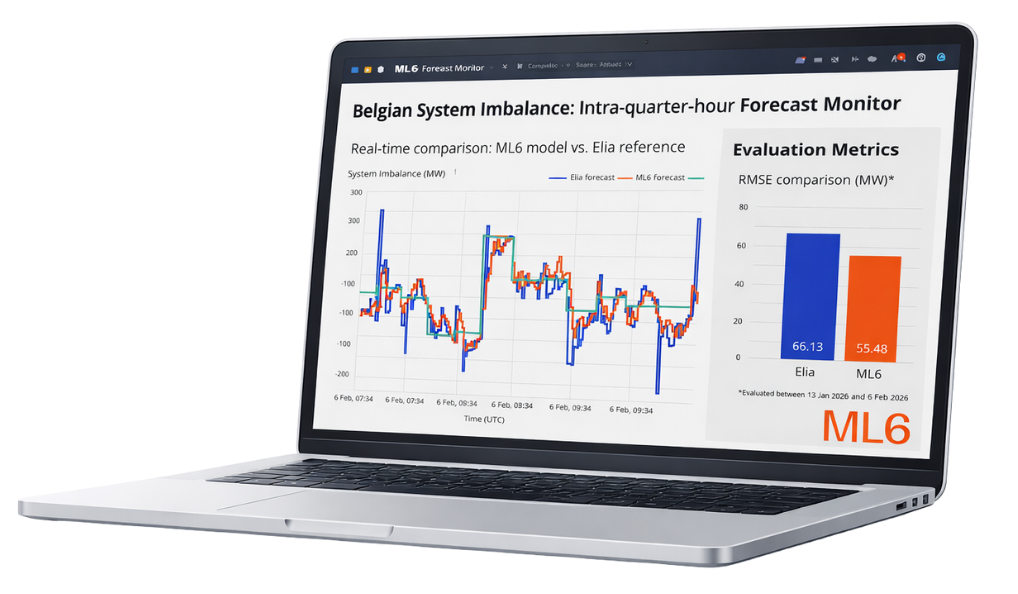
See forecasting in action.Explore our live AI-powered Energy Forecast Monitor — an interactive dashboard combining advanced machine learning with real-world energy data. Instead of describing forecasting, we show it in action.

From Complexity To Clarity.

AI ADVISORY
Whether you're a C-level executive, innovation lead, or business strategist, we help you confidently shape your AI vision—pinpointing high-impact use cases and guiding you to the right people, governance, and architecture decisions to accelerate execution.

AI ENGINEERING
Build your bold vision with solid AI. We have deep AI-native expertise and a focus on tangible results. We engineer AI solutions that are robust, secure, and production-ready—seamlessly integrated into your enterprise stack, driving real business impact from day one.
Combine weather, economic, and demographic data to forecast electricity and gas consumption across regions and time horizons
Model future energy scenarios (e.g. electrification, hydrogen growth, carbon pricing) to guide long-term CAPEX and OPEX decisions.
Simulate interactions between gas, electricity, and emerging energy carriers (e.g. hydrogen, biogas) to inform balanced infrastructure investments.
Use machine learning to predict wholesale electricity and gas prices for procurement, hedging, and trading strategies.
Quantify the financial and operational implications of policy shifts (e.g. emission targets, carbon taxes, subsidies).
Use AI to forecast delays and cost overruns in construction and grid expansion projects.
Monitor supplier performance, geopolitical risk, and logistics bottlenecks to proactively mitigate material shortages.
Simulate and track CAPEX projects (e.g. substation upgrades, gas network expansion) to improve visibility and coordination.
Optimize allocation of field crews, materials, and contractors based on demand forecasts and project criticality.
Use NLP to automate documentation, permitting, and compliance processes to accelerate approvals.
Identify high-potential customers for demand response, rooftop PV, or EV programs.
Provide tailored recommendations through apps and portals using smart meter data.
Develop adaptive tariff structures to incentivize load shifting and grid-friendly behavior.
Aggregate customer assets (EVs, batteries, heat pumps) for flexibility markets.
Deploy AI chatbots and predictive models to anticipate service requests and resolve outages faster.
Use IoT and ML to detect anomalies and predict failures before they occur.
Employ AI to optimize dispatch and control of distributed energy resources (DERs). Energy loss detection: Identify and reduce technical and non-technical losses in transmission and distribution networks.
Identify and reduce technical and non-technical losses in transmission and distribution networks.
Use AI to efficiently route and schedule maintenance and inspection crews.
Combine condition-based data and financial models to optimize replacement and refurbishment decisions.
Capture Critical Know-How Before
It’s Gone.
Capture and link engineering documents, incident reports, and operational knowledge.
Use AR/VR and generative AI to train technicians and operators in simulated field conditions.
Summarize lessons learned from maintenance logs, safety reports, and outage resolutions.
Match workforce capabilities to upcoming technology and regulatory needs.
Enable contextual search and Q&A across internal knowledge bases and project records.
Secure your critical infrastructure.
Monitor OT/IT systems for unusual network behavior or intrusion attempts.
Test resilience against coordinated attacks or failures across power and gas networks.
Use AI to classify and respond to cybersecurity events in real time.
Assess vendor risk exposure across software and equipment suppliers.
Model system resilience under extreme weather, cyberattacks, or blackouts to optimize recovery strategies.
WHY WORK
WITH ML6?
Because the energy sector doesn’t need more technology promises — it needs results.
Tailored for Complex
Energy Environments
- Future-proof architectures: Scalable, API-driven, integration-ready
- Proven outcomes: Lower forecasting errors, improved margins, accelerated time-to-market
years of AI native expertise
AI projects delivered
is the average NPS score our customers give us
weeks of average time-to-value
AI-native experts at your fingertips
of time of our engineers is dedicated to deep tech research
BE
inspired.
Stay in the loop with stories from our team, success cases from our clients, and news on what we’re building behind the scenes. Whether it's a deep dive into the latest in AI, a behind-the-scenes look at a real-world implementation, or product updates we’re proud of — here’s what’s been happening lately.

BlogFrom Volatility to Value: Outsmarting the Belgian System Imbalance.
Executive Summary In liberalized power markets, real-time instability is no longer just an engineering problem - it is a significant financial risk. As the energy transition accelerates, the ability to anticipate system imbalance has become the key to avoiding penalties and capturing value. Belgium serves as a sharp test case for this universal challenge: with an average of €188M in yearly imbalance costs locally, the value of precise, real-time signals is undeniable. This post kicks off a two-part series on how we solved this challenge. We built a production-grade AI system that doesn't just work in theory - it outperforms the Belgian TSO’s own reference forecast by 16% under live, operational constraints. While Part 1 focuses on the intelligence and results behind this edge, Part 2 will reveal the MLOps machinery that keeps it running 24/7.
BlogWhy You Need a GenAI Gateway
Generative AI is ubiquitous these days, and organizations are rapidly integrating GenAI into their business processes. However, building GenAI applications comes with its own set of specific challenges. The models are often large, meaning inference costs for running these models can quickly get out of hand, and model selection often requires balancing performance against costs and latency. Other common challenges include the misuse of generative models or data leakage. While implementing measures such as rate limiting, monitoring, and guardrailing in your GenAI applications can help overcome these problems, doing so for every individual project brings significant overhead for your engineering teams. It also becomes easy to lose track of global usage of generative AI within your organization and leads to many cases of reinventing the wheel as teams solve the same problems over and over again.
BlogSmart energy: how to make your home battery smart and save money?
A home battery might be called “smart” because it connects to an app that allows the home owner to track their usage. But wait, what if there’s more? Let’s take a look at how you can make a battery smarter by connecting it to external inputs such as daily energy prices and weather. This can lower the pressure on the grid by reducing the peak usage, and when switching to a dynamic pricing contract this can also save you money. In this blogpost we demonstrate a system that can save up to 35% on electricity costs.